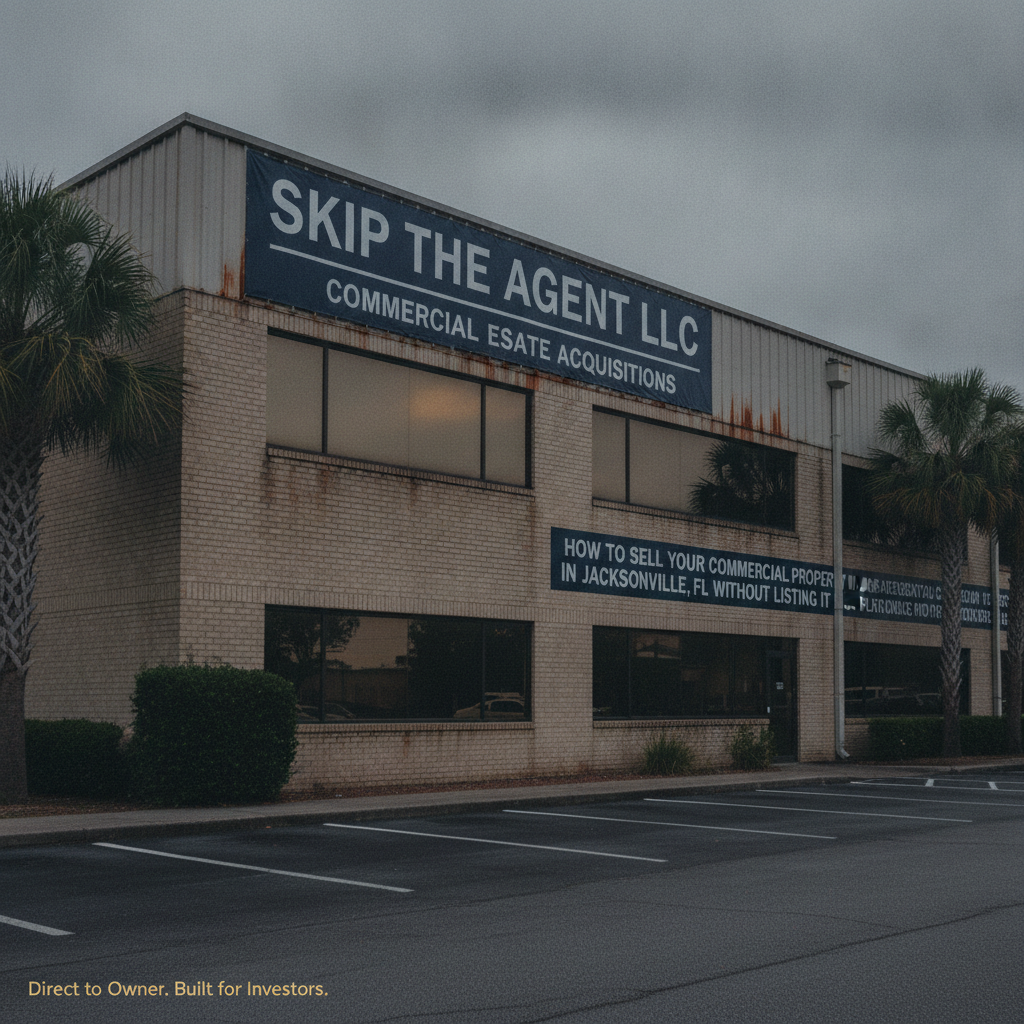
How to Sell Your Commercial Property in Jacksonville, FL Without Listing It Publicly
Selling a commercial property in Jacksonville without a public listing means going directly to a vetted buyer through a private transaction, skipping MLS exposure, broker commissions of 4–8%, and the 6–12 month public marketing cycle. Direct sales in Jacksonville typically take longer than brokered deals for stabilized assets, but they can net more when the owner is motivated by privacy, tenant stability, or speed rather than maximum price discovery. Skip The Agent connects Jacksonville owners with verified commercial investors directly, with transparent offer math and no agents in the middle.
You own a small office building off Southside Boulevard, a strip center in Arlington, or an industrial bay near the port, and you’ve decided you’re done. Maybe the tenants are steady but the phone calls aren’t. Maybe you’ve been holding since the ’90s and your CPA is telling you it’s time. Either way, the question isn’t whether to sell. It’s how to sell without turning your property into a public spectacle on LoopNet for six months.
This guide walks through the financial case for a direct commercial sale in Jacksonville, who it’s actually right for, the step-by-step process, and the mistakes that quietly cost owners tens of thousands of dollars. If you own real estate commercial assets in Northeast Florida and you’re weighing your exit, read this before you sign anything.
The Financial Case for Selling Direct
Most Jacksonville owners assume a broker is the default. It isn’t. It’s one of three paths, and it’s not always the best one.
Here’s the math that gets ignored in the pitch meeting.
A traditional listed commercial sale in Florida typically costs the seller 4–8% of the sale price in broker commissions, plus marketing fees, staging costs for higher-end assets, and roughly 4–8 months of holding time from listing to close for stabilized properties. On a $2.5 million retail strip center, that’s $100,000 to $200,000 in commission alone, before you factor in another 3–5% in closing costs, taxes, and legal fees.
A direct sale to a vetted buyer eliminates the commission line entirely. It also eliminates the marketing exposure, the parade of tire-kickers pulling financials to price their own deals, and the retrade risk that comes with a long due diligence window.
A direct commercial sale in Jacksonville typically saves the seller 4–8% in broker commissions and closes as a private transaction, with no MLS exposure and no public marketing period. Timelines vary: motivated cash buyers can close in 30–60 days, while brokered stabilized-asset sales usually run 4–8 months. The trade-off is price discovery, meaning direct offers should be evaluated against a real cap-rate valuation, not a wishful pro forma.
The catch: direct sale timelines for stabilized assets that go through fragmented buyer channels can stretch to 6–12+ months if the seller isn’t matched with a pre-qualified buyer. That’s the difference between a wholesale-style flip and a targeted direct-to-owner acquisition. The model matters.
What actually drops to the bottom line
On a $2.5M Jacksonville property:
- Brokered sale: $2.5M sale price minus ~5% commission ($125,000) minus ~3% closing costs ($75,000) equals roughly $2.3M net, in 4–8 months.
- Direct sale, well-matched buyer: $2.35M–$2.45M offer minus ~2% closing costs (buyer often covers title), equals roughly $2.3M–$2.4M net, in 30–75 days.
The gross offer is often lower in a direct sale. The net can be equal or higher, and the time-to-cash is dramatically shorter. That’s the honest math.
Who Is a Good Candidate for a Direct Commercial Sale?
Not every owner. Being clear about this is the whole point.
1. Long-hold owners with strong equity positions
If you bought your Baymeadows office building in 2004 and it’s mostly depreciated, you’re not trying to squeeze the last 3% out of the market. You want a clean exit, minimal disruption to tenants, and a check. Direct sale is built for this.
2. Absentee and out-of-state owners
Northeast Florida has a heavy concentration of out-of-state ownership on small-to-mid retail, office, and industrial. If you’re managing a Jacksonville asset from New Jersey or California, the last thing you need is a six-month listing cycle requiring you to fly in for showings.
3. Estate and inherited property situations
Heirs who inherit commercial parcels rarely want to run a public marketing process. They want a straightforward buyer, clean title work, and proceeds split according to the estate plan. A direct sale bypasses the emotional and logistical weight of a full brokered campaign.
4. Management-fatigued owners
Vacancy creeping up. HVAC replacement looming. A problem tenant. If you’re mentally out of the game, the property will keep bleeding while you shop it publicly. A direct sale converts a stalled asset into cash before the next capex event hits.
5. Partnership dissolutions and 1031 pressure
When partners want out or a 1031 exchange clock is running, speed and certainty of close outweigh top-of-market pricing.
6. Owners who value privacy
Not everyone wants their tenants, competitors, or neighbors seeing their property on LoopNet. For a lot of Jacksonville small business owners who occupy their own real estate, that alone is worth the trade-off.
When a Direct Sale Is NOT the Right Choice
This is where most direct-buyer companies stop being honest. We won’t.
If your property is a trophy asset in a hot submarket, a Class A industrial building in AllianceFlorida, a fully leased medical office at Baptist South, a newer multifamily (5+ units) property in Riverside or San Marco, you should probably list it. Competitive bidding from institutional buyers in strong submarkets often produces a sale price that more than covers the commission.
If you have unlimited time and no urgency, and you’re comfortable with a 6–12 month marketing cycle, public exposure, and multiple rounds of buyer due diligence, a broker with a strong institutional book can maximize price discovery.
If your property requires specialized positioning, a value-add repositioning story, a redevelopment play with entitlement upside, a complex sale-leaseback, an experienced commercial broker who tells that story well can add real value beyond their fee.
If you don’t know your number, meaning you have no idea what your property is worth on a cap rate basis, get a broker opinion of value or an appraisal first. Never sell direct without knowing what a fair market offer looks like. That’s how owners get burned, and it’s why our whole model runs on transparent offer math.
For the deeper trade-off analysis on this, see our guide on How Commercial Real Estate Wholesale Deals Work.
The Step-by-Step Direct Acquisition Process
Here’s what a well-run direct commercial acquisition actually looks like from the owner’s side. No mystery, no theatrics.
Step 1: Initial conversation and situation assessment
A 15–20 minute call. What’s the property? What’s the rent roll? What’s your timeline? What’s driving the decision? This is where we figure out if a direct sale even makes sense for you. If it doesn’t, we say so.
Step 2: Property data collection
We ask for what a serious buyer needs: current rent roll, T-12 operating statement, tax bills, insurance premiums, any recent capex, existing loan payoff (if any), and known deferred maintenance. If you don’t have some of these, we help you assemble them.
Step 3: Valuation and offer construction
This is where our fair-math mandate lives. We build the offer using:
- Current in-place NOI
- Market cap rate for the asset class and Jacksonville submarket
- Deferred capex and near-term risk (roof, HVAC, lease rollover)
- Comparable direct-buyer trades in the last 12 months
For context, Jacksonville industrial cap rates in 2025–2026 have generally traded in the 6.5–7.5% range for stabilized product, retail strip centers in the 7.0–8.5% range depending on tenancy, and small office in the 8.0–9.5% range given the ongoing office repricing. We show you the math. You see the assumptions.
Step 4: Written offer with transparent breakdown
You receive a written offer with the cap rate assumption, NOI used, deductions for repairs, and the resulting price. Nothing hidden.
Step 5: Buyer matching
If you accept in principle, we match the property to a vetted investor in our network who buys this asset class in this market. Syndicators, family offices, private equity buyers, and 1031 exchangers. Their capital is verified before the offer is finalized. See more on the buyer side at our investor page.
Step 6: Purchase and sale agreement
A clean, market-standard commercial PSA. Florida commercial transactions carry specific disclosure and entity-authority requirements, and you should have a Florida commercial attorney review any contract before signing. We recommend it every time.
Step 7: Due diligence (typically 21–45 days)
Buyer inspects, reviews title, and often orders a Phase I environmental report per ASTM E1527-21 standards. For properties with historical industrial use, prior gas station operation, or dry cleaner tenancy, Phase II may follow.
Step 8: Closing
Title company or attorney closing. Wire hits your account. Deed records. Done. Typical direct closings from PSA signature to funding run 30–60 days for cash buyers, longer if the buyer is financing.
Common Mistakes Jacksonville Owners Make
These are the ones we see repeatedly.
1. Not knowing your NOI before entering conversations
If you don’t have a clean trailing 12-month operating statement, you’re negotiating blind. Reconstruct it before you talk to anyone.
2. Pricing off gross rent instead of NOI
Buyers price commercial off net operating income and cap rate. Not gross rent. Not what you paid in 2008. Not what Zillow says.
3. Accepting the first offer without a comparison point
Even in a direct sale, get a second opinion. A broker opinion of value is free and takes 48 hours.
4. Signing exclusivity agreements with unknown buyers
Never sign a long exclusivity period with a buyer whose track record you can’t verify. If they’re real, they can close in a reasonable window.
5. Ignoring the retrade risk
Some direct buyers write high offers to tie up the property, then discover “issues” during due diligence and drop the price 15%. Ask any direct buyer for references from three sellers they’ve closed with in the last 12 months.
6. Not planning for the tax hit
Depreciation recapture and capital gains on a long-hold Jacksonville property can be substantial. Talk to your CPA about a 1031 exchange, an installment sale, or an opportunity zone reinvestment before you close, not after.
7. Listing publicly when discretion matters
Once your property hits LoopNet, tenants see it, competitors see it, and your leasing leverage drops. If privacy matters, don’t list.
For more on the private sale process, our guide on How to Sell Vacant Commercial Land Directly Without a Broker in Jacksonville, FL covers land-specific considerations, and the Miami direct-sale guide walks through similar Florida-market dynamics.
Why Jacksonville Specifically
Jacksonville’s commercial market has its own rhythm. Port-driven industrial demand remains strong through 2026, with logistics and warehouse product moving faster than the national average. Retail is bifurcated: grocery-anchored and daily-needs centers trade at compressed cap rates, while unanchored strip centers with weaker tenancy sit longer. Office is still repricing, particularly outside the CBD, and small owner-user office is often better suited to direct sales than public listings.
The city also has a heavy concentration of small-to-mid commercial assets under 25,000 SF held by local investors and family entities. LoopNet and Crexi listings in Jacksonville show an average building size around 21,000 SF for sale, which is exactly the profile where direct acquisitions work well. Institutional buyers don’t want to write $2M checks. Local and regional investors do, and that’s the buyer pool we work with.
The Skip The Agent Model, Plainly
We’re not a brokerage. We don’t list properties. We’re a direct acquisition company that sources off-market commercial deals in Jacksonville and other US markets, then matches them with verified investors who buy that asset class. Our economics work only when the seller reaches a fair outcome, because lowball offers get rejected and we don’t get paid on rejected offers.
That means the offer you get from us is grounded in real market math: current NOI, current cap rates, real capex assumptions. Not a hopeful number designed to tie up the property. If the fair number doesn’t work for you, we say so, and sometimes we recommend a broker instead. That happens more often than you’d expect, and it’s how we earn the referrals that keep this business running.
If you own commercial property in Jacksonville and you’re ready to see what a transparent direct offer looks like, reach out here. No pressure. No obligation. Just clear math and a straight conversation.
Frequently Asked Questions
How much does it cost to sell a commercial property without a broker in Jacksonville?
Selling direct eliminates the 4–8% broker commission entirely, saving between $100,000 and $200,000 on a typical $2.5 million Jacksonville asset. You’ll still pay standard closing costs, title fees, and any attorney review, which usually total 1–3% of sale price depending on structure. Some direct buyers, including Skip The Agent’s investor network, cover title and closing costs on their side, further reducing the seller’s out-of-pocket.
How long does a direct commercial sale take in Jacksonville compared to a listed sale?
A well-matched direct commercial sale in Jacksonville typically closes in 30–75 days from offer acceptance, versus 4–8 months for a stabilized brokered listing. Fragmented direct-buyer channels without a pre-qualified investor pool can stretch to 6–12 months, so the buyer network matters more than the “direct” label. Cash buyers with committed capital close fastest, while financed buyers add 15–30 days for lender processing.
What types of commercial properties sell best through a direct acquisition in Jacksonville?
Small-to-mid commercial assets under 25,000 SF, including retail strip centers, small office, industrial and warehouse, mixed-use, mobile home parks, self-storage, and multifamily (5+ units), sell best through direct acquisitions in Jacksonville. Trophy assets in hot submarkets, like Class A industrial in AllianceFlorida or newer multifamily in San Marco, often perform better through a competitive brokered process. The determining factors are asset quality, buyer pool depth, and seller motivation.
Do I need an attorney to sell commercial real estate in Florida without a broker?
Yes, you should have a Florida commercial real estate attorney review the purchase and sale agreement before signing, even though it isn’t legally required. Florida commercial transactions carry entity-authority, disclosure, financing, and tax structuring issues that residential deals don’t, and skipping legal review shifts risk directly onto the seller. Expect attorney fees of $2,500–$7,500 for a straightforward commercial sale review.
How do I know if a direct commercial buyer is offering a fair price?
Compare the offer to your property’s NOI divided by the current Jacksonville market cap rate for your asset class: industrial is trading around 6.5–7.5%, retail strip centers 7.0–8.5%, and small office 8.0–9.5% in 2025–2026. A fair offer should show the cap rate used, the NOI applied, and any deductions for deferred capex, all in writing. Any buyer unwilling to break down their offer math transparently is not a buyer you should sign an exclusivity agreement with.
Will selling my Jacksonville commercial property directly hurt my tenants or leasing situation?
Selling directly generally protects tenants and leasing better than a public listing because there’s no MLS exposure, no signage, and no showing traffic tipping tenants off that the property is for sale. Public listings often trigger tenant anxiety, lease renewal delays, and reduced landlord leverage during negotiations. A direct sale can close with tenants never knowing the property was marketed at all.
What documents do I need to sell my commercial property directly in Jacksonville?
You’ll need the current rent roll, trailing 12-month operating statement (T-12), most recent property tax bill, current insurance declarations page, existing loan payoff statement if applicable, any environmental reports, and a summary of capital improvements from the last 5 years. Buyers will also request executed leases, service contracts, and any pending litigation disclosures during due diligence. Assembling this package before the first buyer conversation shortens your timeline by 2–4 weeks.
Can I sell my Jacksonville commercial property directly if it still has a mortgage on it?
Yes, most direct commercial sales in Jacksonville involve properties with existing mortgages, and the loan payoff is handled at closing through the title company. The buyer’s funds cover the loan balance first, then remaining proceeds go to you as the seller. Prepayment penalties, defeasance costs on CMBS loans, or yield maintenance clauses can materially affect your net, so pull your loan documents and get an actual payoff quote before finalizing the offer.
Written by Addai Lewellen and Grant Umali, co-founders of Skip The Agent LLC. Addai brings deep experience in commercial real estate acquisitions and deal structuring across national markets. Grant leads operations, marketing, and investor relations. They handle every commercial deal personally, reach them at skiptheagent.llc/commercial or (574) 702-1622.
Have a Commercial Property to Sell?
We buy directly from owners — no agent, no commission, no public listing. Get a direct offer within 48 hours on any commercial asset above $500K.
All commercial assets above $500K · Nationwide · Response within 48 hours
Not ready to call yet?
Get our latest market updates, seller guides, and real estate insights delivered straight to your inbox. No spam, no pressure.
One email. No spam. No pressure.