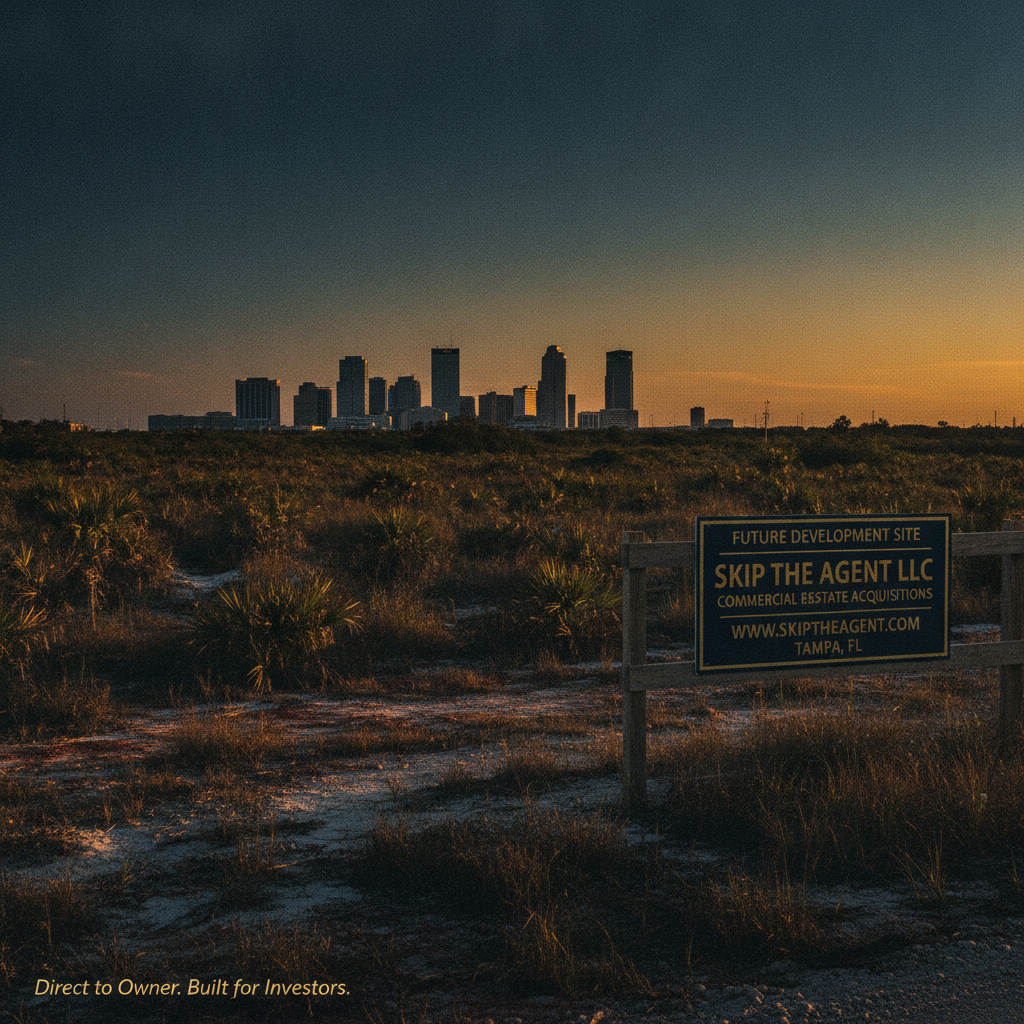
How to Sell Vacant Commercial Land Directly Without a Broker in Tampa, FL: A Complete Guide
Selling vacant commercial land directly in Tampa means bypassing public listings and MLS exposure, connecting straight with vetted investors who price the parcel off residual land value tied to the intended end use. In 2026, Tampa industrial land is being underwritten against 7.5 to 7.6% exit cap rates and roughly $154 per SF warehouse pricing, while retail sits near 6.69% caps and $269 per SF, and those improved‑asset benchmarks are what set what a builder will actually pay for your dirt. Skip The Agent works direct to owner, matching Tampa landowners with buyers already underwriting parcels in the I-4 corridor, Brandon, Riverview, and the urban core, without agents, listings, or commissions.
If you own a vacant commercial parcel in Tampa, Hillsborough, or eastern Pinellas County and property taxes, holding costs, or an inherited situation are pushing you toward a sale, the first thing you need to understand is that raw land does not price like an income property. It prices off what someone can build on it and sell or lease at exit. That single fact changes how you should approach the entire process.
This guide walks through what vacant commercial land actually is in the Tampa market, who owns it, why they sell, how developers and investors really value it, and how a direct-to-owner sale compares against a traditional listed sale. If you want the short version of who we work with and how, start at /commercial/sellers.
What Counts as Vacant Commercial Land in Tampa
Vacant commercial land is any unimproved parcel zoned or entitled for a non-residential or mixed-use commercial purpose. In Hillsborough County that typically includes:
- Industrial and flex-zoned parcels along the I-4 corridor, near Port Tampa Bay, and in submarkets like Plant City and East Tampa
- Retail pad sites and strip center land in Brandon, Riverview, Wesley Chapel edges, and inside city limits along major arterials
- Multifamily-entitled land (5+ units) across Seminole Heights, West Tampa, Ybor edges, and suburban infill sites
- Office and medical office parcels near Westshore, downtown, and USF/Fowler corridor
- Mixed-use land carrying PD (Planned Development) or CG (Commercial General) zoning
- Larger assemblages in growth-path submarkets east and south of the city
For the purposes of this guide, we are focused on parcels realistically valued at $500,000 and above. Smaller residential infill lots and single-family teardowns follow different rules and different buyer pools.
Who Actually Owns This Land, and Why They Sell
Most owners of Tampa commercial land fall into a handful of recurring situations. Recognizing yours matters, because it shapes the timeline, the tax picture, and what you should prioritize in a sale.
Long-hold families and estates. A parent or grandparent bought a Brandon corner in the 1980s. The heirs live out of state, do not want to develop it, and are paying taxes on land generating zero income. Estate deadlines, cost basis step-ups, and sibling disagreements typically drive the timing.
Retiring developers and builders. They accumulated pad sites during earlier cycles and are winding down. They understand value but want a clean exit without listing every parcel publicly.
Investors caught between cycles. They bought land in 2021 or 2022 planning to build multifamily or industrial, then interest rates rose and pro formas broke. They need liquidity without signaling distress on LoopNet or Crexi.
Original farm and grove families in eastern Hillsborough. Growth has swallowed old citrus and cattle land in Plant City, Riverview, and south county. The land is now worth far more than the operating income, and the family wants a clean sale.
Out-of-state absentee owners. They bought speculatively during Florida’s population surge, never developed, and now want out because managing entitlements from another state is exhausting.
If any of that sounds familiar, the good news is that Tampa’s underlying fundamentals remain strong, which means real buyers exist for real dirt at real prices.
How Investors and Developers Actually Value Vacant Commercial Land
This is where most owners get frustrated with the process. A land buyer is not paying you based on a cap rate today, because your land produces no NOI. They are paying you based on what the finished project will be worth minus construction costs, soft costs, financing, developer profit, and risk.
That calculation is called residual land value, and every serious buyer runs it before making an offer.
Vacant commercial land in Tampa is priced off the residual land value of the intended end use, not off in-place cap rates. A developer takes projected stabilized rent, applies the current market cap rate (7.5 to 7.6% for industrial, 5.5 to 7.0% for multifamily, 6.69% for retail in Q1 2026), subtracts hard costs, soft costs, financing, and required developer profit, and whatever is left is what the land is worth to them.
The Improved-Asset Benchmarks That Drive Tampa Land Pricing in 2026
Because land is back-solved from finished-product values, here are the numbers Tampa buyers are actually plugging into their spreadsheets right now:
- Industrial and warehouse: approximately 7.2% average cap rate on recent industrial trades with about $1.2B in Q3 2026 sales volume, and roughly 7.6% cap with about $154/SF pricing on warehouse investment sales over the trailing twelve months, per data referenced in the Florida Cap Rates 2026 report.
- Multifamily (5+ units): roughly 5.5% to 7.0% depending on vintage and submarket. Sources disagree on the metro average, institutional Class A samples report the mid-5s, broader all-product surveys put Tampa nearer 6.2% to 7.1%, so treat any single headline figure with caution.
- Retail: approximately 6.69% average cap rate and $269/SF on Q1 2026 trades; NNN credit-tenant deals compress into the 5.0% to 6.0% range.
- Office: approximately 7.0% cap rate in Q1 2026, with a 10.0% vacancy rate and $32.00/SF asking rents, per the Tampa Office Q1 2026 report.
Tampa primary-market cap rates run 50 to 100 basis points tighter than secondary Florida markets like Jacksonville and Lakeland, and 100 to 200 bps tighter than tertiary markets. That premium is a direct function of highway access, population density, and Port Tampa Bay proximity.
Price Per Acre and Price Per Buildable Foot
For raw land, expect buyers to talk in two units:
- Price per acre for larger, less-entitled parcels
- Price per buildable square foot (or per unit) for entitled, closer-to-shovel-ready sites
A ten-acre industrial parcel near a Port Tampa Bay distribution corridor with utilities at the property line will price very differently from a ten-acre parcel forty minutes east with no water, no sewer, and a rezoning still required. Utilities, access, wetlands, environmental history, and existing entitlements can swing land value by 30% to 60%.
What Sophisticated Buyers Underwrite Before Making a Real Offer
If you receive an offer without any of the following having been examined, treat that offer with skepticism. Real buyers analyze:
- Zoning and future land use designation under Hillsborough County or City of Tampa
- Utility availability: water, sewer, stormwater capacity, electric
- Access and curb cuts: FDOT approvals, turn lanes, median cuts
- Wetlands, floodplain (Zone AE, X, VE), and SWFWMD constraints
- Environmental history, including any Phase I ESA under the ASTM E1527-21 standard if prior uses raise concerns
- Impact fees and concurrency for the intended use
- Comparable land sales and finished product comps in the submarket
- Traffic counts (for retail and QSR pad sites) and demographic radius data
An owner selling directly should have as much of this information ready as possible. Missing data does not kill deals, but it lengthens due diligence and gives buyers reasons to reprice.
Typical Deal Timelines for Vacant Commercial Land in Tampa
Land deals typically take longer than income-property deals for one reason: buyers need feasibility periods to confirm they can actually build what they underwrote.
- Initial LOI to signed PSA: typically 10 to 30 days
- Feasibility / due diligence period: typically 60 to 120 days (longer for rezoning or entitlement contingencies)
- Extensions: common when rezoning, site plan approval, or utility commitments are required
- Closing after feasibility: often 15 to 30 days
An all-cash buyer who is willing to close on current entitlements can move in 30 to 60 days total. A merchant developer who needs a rezoning and site plan approval can push the timeline to 9 to 18 months, usually with non-refundable earnest money deposits stepping up along the way.
The Traditional Listed Path: When It Actually Makes Sense
We do not pretend a direct sale is right for everyone. There are clear situations where a traditional listed sale through a qualified commercial land broker produces a better outcome:
- You own a truly trophy parcel in Westshore, downtown Tampa, or a Water Street-adjacent block, where a public marketing campaign will attract national developers and REITs bidding against each other.
- You have unlimited time and holding capacity. If taxes, financing, and family pressure are not factors, a 12 to 18 month marketing process with a specialist broker can occasionally squeeze the last dollar out.
- You need price discovery on a truly unique parcel with no obvious comps, where competitive bidding may be the only way to establish value.
- You want maximum optionality and are comfortable with the corresponding fees, timelines, and public exposure.
If any of the above describes you, hire a qualified commercial land broker. That is honest advice, and it is the same advice we give owners on the phone every week.
When a Direct Sale Is the Better Fit
A direct-to-owner sale generally makes more sense when:
- Time matters more than the last 3 to 5% of price. Estate deadlines, tax planning, partnership dissolutions, and 1031 replacement clocks all favor certainty.
- You do not want the parcel publicly listed. Public listings can complicate tenant negotiations on adjacent property, tip off neighbors, or create family friction.
- The property has hair on it. Wetlands, environmental history, split zoning, or expired entitlements often perform better with a targeted buyer than with a broad marketing campaign that invites price chipping.
- You already know what you want and just need a real buyer. If your number is grounded in current comps, a direct sale gets you there without months of showings and re-trades.
For a broader look at how these sales are structured, our guide on How Commercial Real Estate Wholesale Deals Work covers the mechanics in plain language.
How Skip The Agent’s Direct Acquisition Model Applies to Vacant Land
Skip The Agent is not a broker. We are a direct-to-owner acquisition platform that sources off-market commercial parcels and connects them with a vetted network of investors, developers, family offices, and syndicators actively underwriting Tampa deals.
Here is how it works for a landowner:
- You contact us. You describe the parcel: location, size, zoning, utilities, entitlements, and your timing.
- We build the underwriting. We back-solve residual land value against current Tampa cap rates for the most likely end use, pull comparable land sales, and identify feasibility risks.
- We present a real number, with the math shown. If our number does not clear your minimum, we tell you so, and if a traditional listed sale would serve you better, we say that too.
- We match to a specific buyer. No public listing, no LoopNet, no CoStar. The parcel goes directly to investors already looking for that submarket and asset type.
- We close through title. Standard PSA, standard feasibility period, standard escrow. Buyer pays closing costs on our typical structures.
For investors on the other side of the table, we source parcels that never touch Crexi or LoopNet, which is the entire point. If you are actively acquiring in Tampa, start at /commercial/investors.
Why Direct-to-Owner Transactions Benefit Both Sides
The traditional listed model made sense in an era when buyers and sellers could not find each other. That era is over. Today, the real friction is not discovery. It is process, exposure, and fees.
For the seller, a direct sale means:
- No 4% to 6% commission on a land transaction
- No public listing that neighbors, tenants, or competitors can see
- Faster feasibility and closing on straightforward parcels
- A single point of contact who is aligned with your outcome, not with generating a listing fee
For the buyer, a direct sale means:
- Access to parcels before they are shopped to twenty other groups
- Cleaner competition and less bid-fatigue
- Direct dialogue with the decision-maker
- Better pricing discipline, because deals are underwritten against real math, not marketing hype
The reason this model works long-term is simple. Lowball offers get rejected. Sellers walk away. We do not make money. The only sustainable direct-acquisition business is one where the seller reaches a fair outcome grounded in current market data. That is why our offers are built off the same Tampa cap rates, price-per-SF benchmarks, and residual land calculations that any qualified developer would use.
If you want more context on what is moving in the broader market, see our Tampa, FL Commercial Real Estate Market Update and the companion piece on How to Sell Your Commercial Property in Tampa, FL Without Listing It Publicly.
Practical Next Steps for Tampa Landowners
Before you talk to anyone, gather what you have:
- Parcel ID and legal description from the Hillsborough County Property Appraiser
- Current zoning and future land use designation
- Any surveys, environmental reports, or wetland delineations in your files
- Prior appraisals, if any
- Utility letters or capacity commitments, if applicable
- Notes on any prior offers or LOIs received in the last 24 months
The more of this you have ready, the faster a serious buyer can underwrite and the less room there is for price chipping later.
If you are ready to have a real conversation about your parcel, or you just want a second opinion on a number you have already been quoted, reach out through /commercial/contact. We will tell you what we see, show you the math, and if a listed sale is genuinely better for your situation, we will say so.
Frequently Asked Questions
How much is my vacant commercial land in Tampa actually worth in 2026?
Vacant commercial land in Tampa is priced by back-solving from the residual land value of the intended end use, not by applying a cap rate to current income. Buyers take projected stabilized rents, apply current 2026 Tampa cap rates (roughly 7.5 to 7.6% for industrial, 5.5 to 7.0% for multifamily, 6.69% for retail per Q1 2026 data), subtract hard and soft construction costs, financing, and developer profit, and the residual is your land value. Utilities, entitlements, wetlands, and access can swing that figure by 30% to 60%.
How long does it typically take to sell vacant commercial land directly in Tampa?
A direct all-cash sale on a ready-to-build parcel typically closes in 30 to 60 days from LOI to funding. Deals requiring a feasibility period usually run 60 to 120 days, and parcels needing rezoning or site plan approval can extend to 9 to 18 months with staged non-refundable deposits. Timing depends more on entitlement risk than on buyer speed.
Do I need a broker to sell commercial land in Florida?
No, Florida law does not require a landowner to use a broker to sell their own commercial property. Selling directly avoids the typical 4% to 6% land brokerage fee but requires you to handle buyer vetting, contract negotiation, and due diligence coordination yourself, which is where a direct acquisition platform like Skip The Agent typically steps in.
What’s the difference between selling land directly and listing on LoopNet or Crexi?
A public listing on LoopNet or Crexi markets the parcel to everyone, including tire-kickers, competing owners, and tenants of adjacent properties, and typically involves a broker fee. A direct sale routes the parcel to a specific pre-vetted buyer who is already underwriting that submarket and asset type, keeps the transaction private, and avoids public exposure that can complicate other business relationships.
How do buyers value Tampa industrial land specifically in 2026?
Tampa industrial land in 2026 is priced against a 7.5 to 7.6% exit cap rate and roughly $154/SF stabilized warehouse value, per the Florida Cap Rates 2026 report. A developer projects rents (typically $10 to $15/SF NNN depending on submarket), builds a pro forma, subtracts hard costs of roughly $130 to $180/SF for tilt-wall construction, adds soft costs and required profit, and the residual is the land price. I-4 corridor and Port Tampa Bay proximity command premiums.
What if my land has environmental issues or wetlands?
Environmental history and wetlands do not kill a sale, but they change who the buyer is and how the deal is structured. Serious buyers will require a Phase I ESA under the ASTM E1527-21 standard during feasibility, and wetland-impacted parcels typically price against the developable upland acreage rather than total acreage. Direct buyers often handle these parcels better than a broad public listing because they can underwrite the risk instead of walking from it.
Can I sell inherited commercial land in Tampa without going through probate first?
You cannot legally convey title to inherited commercial land until the estate has passed through probate or the property is held in a trust or LLC that has already been transferred. However, you can begin conversations, gather documents, and even sign a purchase agreement contingent on probate closing, which is a common structure. A direct buyer familiar with estate situations will typically work with your attorney on the timeline.
Is now a good time to sell vacant commercial land in Tampa?
Tampa fundamentals in 2026 remain strong, with population growth, I-4 corridor industrial demand, and constrained developable land supply supporting pricing. Cap rates have normalized from 2021 to 2022 lows, which means buyers are more disciplined, but well-located parcels with utilities and clean entitlements are still trading actively. If your holding costs, tax situation, or personal timing favor a sale, the current market supports fair pricing on real parcels.
Written by Addai Lewellen and Grant Umali, co-founders of Skip The Agent LLC. Addai brings deep experience in commercial real estate acquisitions and deal structuring across national markets. Grant leads operations, marketing, and investor relations. They handle every commercial deal personally, reach them at skiptheagent.llc/commercial or (574) 702-1622.
Have a Commercial Property to Sell?
We buy directly from owners — no agent, no commission, no public listing. Get a direct offer within 48 hours on any commercial asset above $500K.
All commercial assets above $500K · Nationwide · Response within 48 hours
Not ready to call yet?
Get our latest market updates, seller guides, and real estate insights delivered straight to your inbox. No spam, no pressure.
One email. No spam. No pressure.