Triple Net Lease Meaning: What an NNN Lease Shifts to Your Tenant, and What It Is Worth When You Sell
A triple net lease is a commercial lease in which the tenant pays base rent plus the property’s taxes, insurance and common area maintenance, so the owner’s income is close to the rent check. That predictability is what buyers pay for: The Boulder Group put the average single-tenant net lease cap rate at 6.82% in the second quarter of 2026, with retail at 6.60%, industrial at 7.25% and office at 7.90%. Skip The Agent buys net leased buildings direct from owners, and we will tell you plainly what your lease, your tenant and your remaining term are worth to a buyer.
This is not legal, tax or investment advice. Every net lease is its own document, and the only version that decides what your building is worth is the one your tenant signed. Have a real estate attorney read it before you rely on anything below.
Two people search for the meaning of a triple net lease. One is a tenant about to sign one. This guide is written for the other: the owner who already has a net leased building, or is about to put a tenant in one, and wants to know what the structure does to the value of the property and to the sale.
The Three Nets, Named
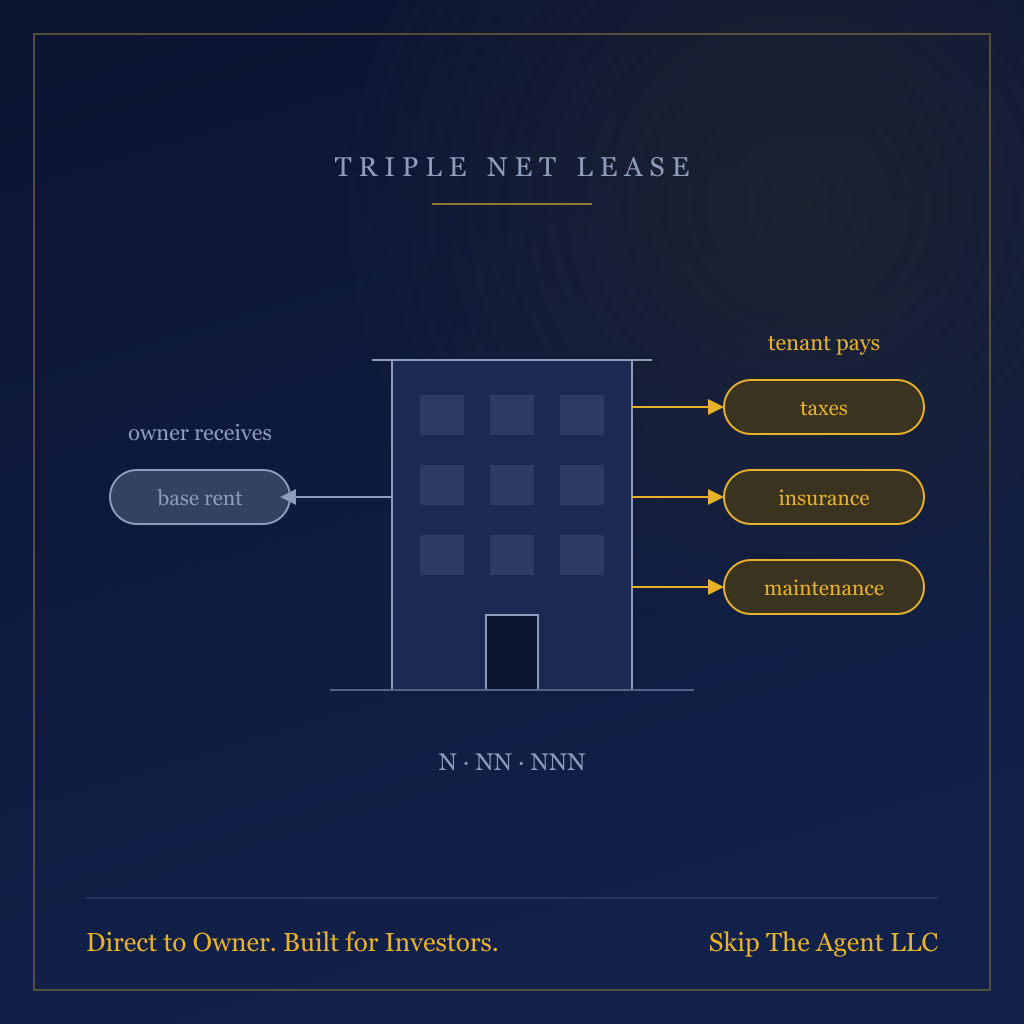
The “nets” are the property’s operating costs, and the lease says which ones move to the tenant. Cornell’s Legal Information Institute defines a net lease as one where the tenant pays base rent “plus some or all of the property’s operating and maintenance expenses,” and breaks it into three steps:
- Single net (N): base rent plus property taxes.
- Double net (NN): base rent plus property taxes and insurance.
- Triple net (NNN): base rent plus property taxes, insurance and common area maintenance (CAM), sometimes with utilities or repairs added.
At the far end sits the absolute net lease, sometimes called a bondable lease, where the tenant also carries the roof, the structure and the parking lot, and bears the risk of rebuilding after a casualty. At the other end is the gross lease, where the tenant pays one number and the owner pays every expense out of it. A modified gross lease splits the difference, usually by making the tenant pay any increase in taxes or insurance above a base year.
The labels are shorthand, and they are loose shorthand. Two leases that both say “NNN” on the cover can put the roof on different people. What matters is the expense section of the lease, and a buyer will read it line by line.
Why the Nets Matter More Than the Rent
Take two buildings with the same net operating income. One is leased gross for $160,000 a year, and the owner pays $40,000 in taxes, insurance and maintenance, for $120,000 of NOI. The other is leased triple net for $120,000 a year, and the tenant pays the $40,000 directly. Same NOI today.
Now raise the insurance bill. On the gross lease, the increase comes straight out of your NOI until the lease rolls and you can reprice the rent. On the triple net lease, it goes to the tenant, and your NOI does not move.
This is not theoretical. A Federal Reserve study of apartment buildings found that average insurance cost per unit rose more than 75% in real terms from 2019 to 2024, and that “a dollar increase in property insurance costs reduces property owners’ net income by about 72 cents.” Those owners were on leases that could not pass the cost through. A net lease owner would have kept close to all of that 72 cents.
Buyers know this, and it is why they accept a lower cap rate, which means a higher price, for income that expense inflation cannot reach.
How a Buyer Prices Your Net Leased Building
The math is the same cap rate math that prices any income property, and our guide to what your commercial property is actually worth walks through it in full. Value equals NOI divided by the cap rate. On a true triple net lease, NOI is close to the base rent, less any costs the lease leaves with you and a reserve for them.
The benchmark buyers are working from is The Boulder Group’s Q2 2026 net lease report: 6.82% overall, 6.60% retail, 7.25% industrial and 7.90% office for single-tenant net lease properties.
The same report shows how much the tenant’s credit moves the number. Quick-service restaurants leased to the corporate parent averaged a 5.85% cap rate. Quick-service restaurants leased to a franchisee averaged 6.85%. Same kind of building, same kind of lease, a full percentage point apart because of who signs the rent check.
Put that on a building with $150,000 of NOI:
| Tenant on the lease | Cap rate | Value |
|---|---|---|
| Corporate QSR | 5.85% | $2,564,000 |
| Franchisee QSR | 6.85% | $2,190,000 |
That is about $374,000 of price that comes from the guarantor and nothing else. If your tenant is a franchisee or a local operator, the buyer is going to price the credit, and so should you before you set an asking number.
The Four Things a Net Lease Buyer Actually Underwrites
1. The tenant’s credit and the guaranty. Who is obligated on the lease, and who guarantees it: a public parent, a private company, a franchisee entity, or one person. A lease signed by a single-location LLC with no guaranty is worth what that LLC is worth.
2. The term remaining. Every month that passes takes a month off the lease. A buyer looking at five years left is underwriting what happens in year six, when the tenant can leave and the building may sit empty while you pay the taxes, insurance and CAM that used to be someone else’s problem. Renewal options belong to the tenant, so a buyer gives you little credit for them. The value of a net leased building is highest when the term is long, and it declines as the term runs down.
3. The rent increases. Many net leases have flat rent or small fixed bumps, often every five years. Flat rent over a long term loses ground to inflation every year, and buyers price that in. A lease with annual increases supports a lower cap rate than one that stays flat.
4. What the lease leaves with you. Roof, structure, parking lot, HVAC replacement, and any cap on what the tenant pays for CAM or on how much a property tax reassessment after your sale can be passed through. Each carve-out is a cost the buyer will reserve for and subtract. A “triple net” lease with the roof and structure on the landlord is worth less than an absolute net lease on the same tenant, and the buyer’s appraiser and inspector will find the difference; our guide to the appraisal and the inspection covers how that reprices a deal after you sign.
Triple Net Lease Pros and Cons, for the Owner
What it gives you:
- Stable NOI. Expense increases go to the tenant, which protects both your income and your value.
- Low management. The tenant runs the property day to day. Many owners hold net leased buildings from a different state.
- A deep buyer pool. Investors completing a 1031 exchange want exactly this product, because it is passive and easy to underwrite. The IRS treats a qualifying swap of investment real estate as a like-kind exchange reported on Form 8824, and our guide to the 1031 exchange clock explains why those buyers are often on a deadline.
What it costs you:
- One tenant is all your income. On a single-tenant building, a tenant that goes dark or files bankruptcy takes your NOI to zero overnight, and all the expenses come back to you.
- Less control over condition. The tenant maintains the property to the standard the lease requires, and not always to the standard you would pick. You find out what deferred maintenance looks like when the lease ends.
- Rent that lags the market. A long lease at a fixed rent is a strength when rates are rising and a weakness when market rents are climbing past yours.
- Reconciliation work. On multi-tenant NNN property, you still collect estimated expenses monthly and reconcile them against actual costs once a year, and tenants audit those numbers.
Read Your Own Lease Before a Buyer Does
A buyer’s attorney will abstract your lease in the first week of due diligence. Do it first, so the answers are already in your offering package and none of them arrive as a surprise renegotiation. These are the clauses that move price:
- The expense section. List every cost and who pays it. Look for the words “roof,” “structure,” “foundation,” “parking,” “capital repairs” and “replacement.” Anything left with the landlord is a reserve the buyer subtracts.
- CAM caps and exclusions. A cap on annual CAM increases means costs above the cap stay with you. Exclusions for management fees or capital items do the same.
- Property tax pass-through after a sale. In a state that reassesses on transfer, your sale can raise the tax bill. Check whether the lease lets the new owner pass that increase to the tenant or protects the tenant from it.
- Rent schedule and options. Write out the rent for every remaining year and every option period. Buyers underwrite the lease as written, so a bump that lands in year 11 of a 10-year term with an unexercised option counts for little.
- Termination and kick-out rights. An early termination right, a co-tenancy clause on retail, or a go-dark right lets the tenant stop operating while still paying rent. Each one shortens the term a buyer will credit you with.
- Assignment and guaranty release. If the tenant can assign the lease and the guarantor walks away on assignment, the credit a buyer is paying for can disappear without your consent.
- Transfer rights. A right of first refusal or first offer in the tenant’s favor, covered below.
Put the answers on one page. An owner who hands a buyer a clean lease abstract with the estoppel already requested closes faster and gives the buyer less room to retrade.
What Comes Up When You Sell
Buyers verify the income before they close. They will ask each tenant for an estoppel certificate confirming the rent, the term, the options and that you are not in default, and a mismatch between that certificate and your rent roll is one of the most common ways a net lease sale reprices late. Our guide to the estoppel certificate covers what to fix before a buyer ever sends one.
Check the lease for a tenant right of first refusal or right of first offer on a sale. Either one can slow a deal down or hand your tenant the building at the price another buyer negotiated.
Watch the supply numbers too. Boulder reported single-tenant net lease supply up 12.5% from the prior quarter, to about 5,800 properties on the market, while the gap between what buyers bid and what sellers ask on retail and industrial was 22 basis points. More listings means your building competes harder for the same pool of buyers, and the ones with long terms and strong credit are the scarce ones.
If you are selling because a lease is getting short or a tenant looks shaky, the timing matters more than the market. The value of a net leased building is set by the lease, and the lease gets shorter every month. If you are trying to sell and stay in the building instead, the sale-leaseback is the same structure in reverse, with you as the tenant.
Skip The Agent buys commercial property direct from owners, net leased buildings included, with no listing and no broker commission. Tell us the tenant, the term and the rent, and we will tell you what a buyer is going to see.
Frequently Asked Questions
What does triple net lease mean?
A triple net lease means the tenant pays base rent plus the property’s three main operating costs: property taxes, insurance and common area maintenance. The owner receives rent that is close to net income, and increases in those costs are the tenant’s responsibility rather than the owner’s.
What is the difference between a triple net lease and an absolute net lease?
An absolute net lease also puts the roof, the structure and casualty risk on the tenant, so the owner has almost no property obligations at all. In a standard triple net lease the owner often keeps the roof and structure, which is a cost a buyer will reserve for and deduct from the price.
Is a triple net lease good for the landlord?
Usually, for income and value. Expense inflation goes to the tenant, the property needs little management, and 1031 buyers compete for it. The trade-off is concentration: on a single-tenant building, losing the tenant takes the income to zero and puts every expense back on the owner.
What cap rate do triple net properties sell for?
The Boulder Group put the single-tenant net lease average at 6.82% in the second quarter of 2026, with retail at 6.60%, industrial at 7.25% and office at 7.90%. Tenant credit moves it a lot: quick-service restaurants leased to the corporate parent averaged 5.85% against 6.85% for franchisee-operated locations.
When is the best time to sell a net leased building?
While the lease still has a long term remaining. Buyers price the risk of the tenant leaving at the end of the term, so value is highest early and falls as the term runs down, especially when fewer than about five years are left.
Written by the Skip The Agent Commercial team. Direct to Owner. Built for Investors. Skip The Agent LLC is a direct-to-owner commercial acquisition company. We are not a licensed real estate brokerage, and nothing here is lending, tax, or legal advice.
Written by Addai Lewellen and Grant Umali, co-founders of Skip The Agent LLC. Addai brings deep experience in commercial real estate acquisitions and deal structuring across national markets. Grant leads operations, marketing, and investor relations. They handle every commercial deal personally. Reach them at skiptheagent.llc/commercial or (574) 702-1622.
Have a Commercial Property to Sell?
We buy directly from owners — no agent, no commission, no public listing. Get a direct offer within 48 hours on any commercial asset above $500K.
All commercial assets above $500K · Nationwide · Response within 48 hours
Not ready to call yet?
Get our latest market updates, seller guides, and real estate insights delivered straight to your inbox. No spam, no pressure.
One email. No spam. No pressure.