Last updated:
San Diego, CA Commercial Real Estate Market Update: Cap Rates, Vacancy, and What's Moving Right Now
San Diego commercial cap rates are averaging 5.11% in 2026, with Class B/C multifamily holding the tightest vacancy at 3.3% while Class A sits at 6.4% as new supply hits the market. Multifamily vacancy reached 4.8% in Q1 2026 (the highest level since 2010), and rising rates have widened the gap between asking prices and what buyers will actually fund, pushing more owners toward direct sale conversations. Skip The Agent connects San Diego owners to vetted investors off-market, no broker, no public listing, no commission stripped off the sale price.
If you own a San Diego commercial asset right now, you are probably weighing one of three things: a maturing loan at a rate that no longer pencils, slower lease-up at a Class A property, or an exit you have been deferring for two or three years waiting for “the market to come back.” The 2026 market is finally giving real signals, and most of them point to selective activity rather than a broad recovery.
This is what the numbers actually say, and what they mean for sellers and investors operating in San Diego County today.
Cap Rates: 5.11% Average, But the Average Hides the Real Story
The headline number from LoopNet shows San Diego commercial real estate trading at an average cap rate of 5.11% in 2026. That figure spans every asset class, from infill multifamily to suburban retail strips to industrial flex space, so the average is useful for orientation but almost useless for decision-making on a specific property.
San Diego commercial cap rates average 5.11% across asset classes in 2026, but the spread is wide: Class A multifamily is trading softer due to 6.4% vacancy, while Class B/C multifamily with 3.3% vacancy is commanding tighter pricing. Industrial and medical office continue to attract aggressive bids, while traditional office assets in submarkets like UTC and Sorrento Valley are repricing meaningfully lower.
The honest read on cap rates right now: buyers are underwriting deals against a higher cost of capital, and they are demanding more yield to compensate. Sellers anchored to 2021 pricing are sitting on the market or pulling back. The deals that close are the ones where the seller has accepted that the math has changed, and the buyer has accepted that quality San Diego real estate is not going to trade at distressed levels.
Vacancy Trends by Asset Class
Multifamily (5+ units)
According to J.P. Morgan Chase’s San Diego multifamily outlook, citing Moody’s data:
- Overall multifamily vacancy: 4.8% in Q1 2026, projected to rise to 5.1% by year-end
- Class B/C vacancy: 3.3%
- Class A vacancy: 6.4%
- New deliveries projected for 2026: approximately 5,900 units
- Rent forecast: +1.2% effective rent growth in 2026 after a 2.0% decline in 2025
The split between workforce housing and luxury units is the most important data point in the entire San Diego market. Tenants are trading down. Class B and C buildings with reasonable rents and basic amenities are nearly full. New Class A deliveries in Mission Valley, Downtown, and Little Italy are absorbing slowly and offering concessions.
Office
The San Diego office vacancy rate sits at 13.6% in Q1 2026, essentially flat from the prior quarter but 60 basis points above the year-ago level, per Kidder Mathews. Total availability has climbed to 17.1%, meaning more space is being marketed even as occupied square footage stabilizes. Leasing activity dropped 16.2% year-over-year.
Industrial and Retail
San Diego industrial continues to outperform most coastal markets, though net absorption has cooled from the 2021–2022 peak. Retail, particularly grocery-anchored and necessity-based centers in submarkets like Carmel Valley, Chula Vista, and North County, remains tightly held and rarely trades on the open market.
What’s Driving Deal Activity Right Now
Three forces are creating motivated sellers in San Diego in 2026:
1. Refinancing pressure. Loans originated in 2019–2021 at sub-4% are maturing into a 6.5–7.5% debt environment. Owners who cannot or will not write a check at refinance are exploring sale.
2. Management fatigue at smaller portfolios. Out-of-state owners of 8 to 40-unit apartment buildings in City Heights, North Park, El Cajon, and Spring Valley are tired of California regulatory load, AB 1482 caps, and remote management costs eating into yields.
3. Estate and partnership exits. A meaningful share of San Diego’s commercial inventory has been held for 25+ years by original owners now in their seventies or beyond. Estate planning, partnership dissolutions, and 1031 timing pressure are driving quiet exits that never hit LoopNet commercial real estate or Crexi listings.
Which Asset Classes Are Moving Fastest
Based on current vacancy and cap rate behavior:
- Class B/C multifamily (5+ units): Most active. Tight vacancy, durable rents, motivated buyer pool.
- Small-bay industrial: Tight supply, fast trades when priced realistically.
- Medical office: Resilient demand, fewer transactions but quick close cycles when one comes available.
- Single-tenant net lease retail: Slower but steady, very rate-sensitive.
- Traditional office: Slowest. Pricing discovery still in progress.
- Hotels: Selective. Coastal performers trade, interior submarkets sit.
For a broader view of how off-market sourcing works in this market, see Off-Market Commercial Real Estate in San Diego, NV: How Serious Investors Source Deals Before Anyone Else.
What Sellers Should Know
If you own a San Diego commercial property and are considering an exit, the math you need to run is not “what was this worth in 2022.” It is “what is my actual net at today’s cap rate, minus commissions, minus carrying cost during a 6 to 9 month listing window, minus retrade risk during due diligence.”
We work directly with owners considering a quiet sale. The full process is outlined at /commercial/sellers.
A direct off-market sale typically makes sense when:
- The property has deferred maintenance or operational issues you do not want exposed in a public listing
- You are an out-of-state or absentee owner and the management load is the actual problem
- A loan maturity is 6 to 18 months out and you want certainty, not optionality
- Estate, divorce, or partnership circumstances require discretion
- You have already tested the market with a broker and pulled back
When a Direct Sale Is NOT the Right Choice
Honest answer: if your property is a trophy asset in a tight submarket (coastal multifamily under 5% cap, prime UTC office tower, irreplaceable retail corner), a competitive listed process with a strong broker will almost always produce a higher gross price. If you have the time, the property condition, and the patience for a 90 to 180 day marketing campaign plus a 60 to 90 day close, a traditional sale through NAR commercial brokerage channels is genuinely the right call. We will tell you that directly during our first conversation if that is what the math shows.
The direct path is built for the situations where time, privacy, or certainty matter more than chasing the last 3 to 5% of price.
What Investors Should Know
San Diego is one of the hardest off-market sourcing environments in the West. Inventory is held tightly, family ownership runs deep, and traditional cold outreach gets ignored. Investors who want first-look access to deals before they touch CoStar or LoopNet need a direct pipeline to motivated owners.
Our investor process is detailed at /commercial/investors. For context on how these transactions are structured, see How Commercial Real Estate Wholesale Deals Work: A Straight-Talk Guide for Sellers and Investors.
Why Direct Off-Market Fits Today’s San Diego Market
When cap rates are repricing and buyers are underwriting conservatively, public listings amplify the friction. Every retrade, every extension, every contingency gets harder when ten parties are watching. Direct transactions between a motivated owner and a verified investor sidestep that entire dynamic. The seller gets certainty and privacy. The investor gets a real deal without a bidding war or recycled inventory. Both sides keep the money that would otherwise be split between listing and buyer-side commissions.
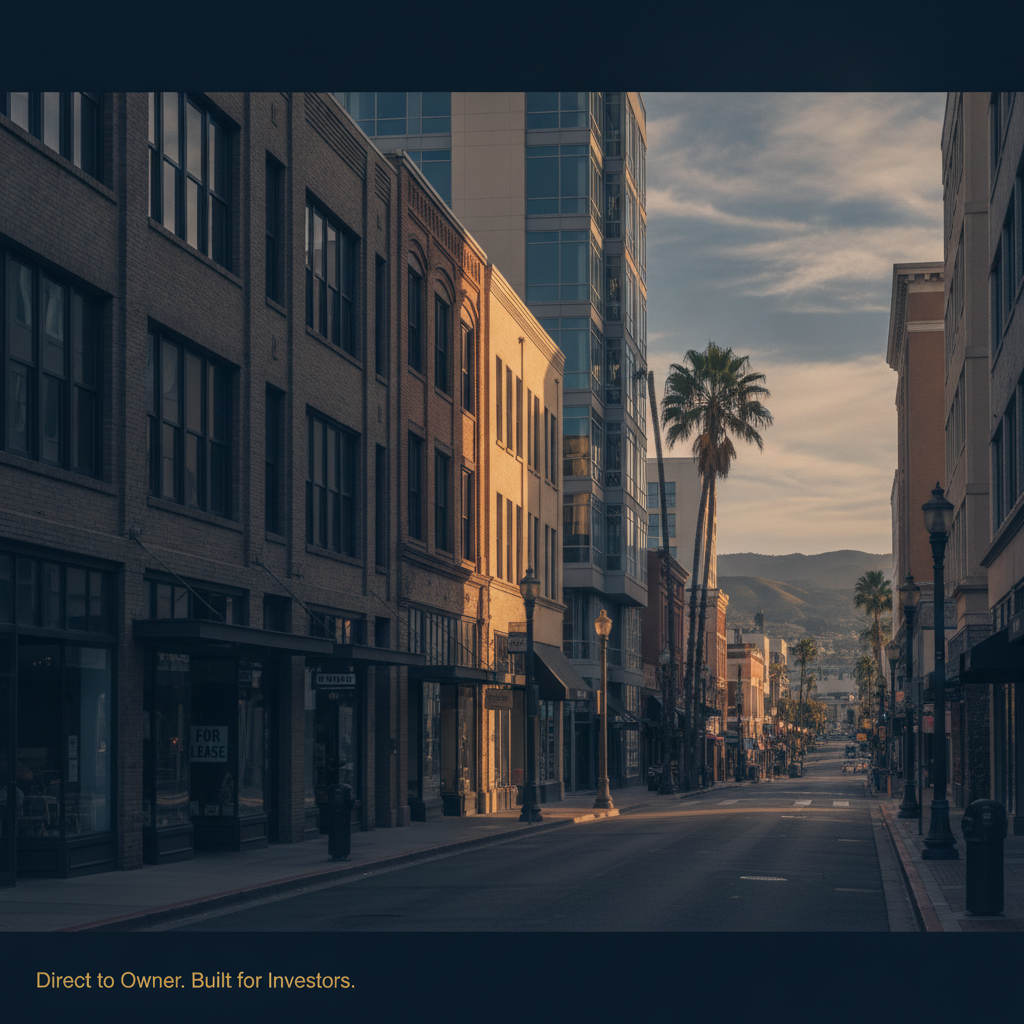
That is the entire reason we built Skip The Agent. Direct to owner. Built for investors.
If you are an owner thinking about a quiet exit, or an investor looking for real San Diego commercial property for sale that is not on the public market, reach out at /commercial/contact.
Frequently Asked Questions
What is the average cap rate for commercial real estate in San Diego in 2026?
The average commercial cap rate in San Diego is 5.11% across asset classes in 2026, according to LoopNet. That figure blends multifamily, industrial, retail, office, and mixed-use, so individual asset cap rates can range from the low 4% area for prime coastal multifamily to 7%+ for repricing office assets.
Why is San Diego multifamily vacancy rising even though demand is strong?
San Diego multifamily vacancy reached 4.8% in Q1 2026 primarily because roughly 5,900 new Class A units are being delivered into the market, pushing luxury vacancy to 6.4% while Class B/C workforce housing stays tight at 3.3%. Tenants are trading down to more affordable units, which is supporting B/C performance and softening Class A rents.
Is now a good time to sell a commercial property in San Diego?
Now is a reasonable time to sell if your property is Class B/C multifamily, small-bay industrial, or medical office, and a difficult time to sell if it is vacant office or a recently delivered luxury asset. The key question is not the market overall but whether your specific asset is in a category where buyer demand currently exists at pricing you will accept.
How do I sell my San Diego commercial property without listing it publicly?
You sell a San Diego commercial property privately by working with a direct buyer network that already has verified investors ready to underwrite. Skip The Agent connects owners with vetted commercial investors off-market, with no public listing, no broker commission, and no signage on the property. The process typically starts with a property review and a direct offer based on current market math.
What asset classes are seeing the most motivated seller activity in San Diego?
Smaller multifamily (5+ units), older retail strip centers, gas stations, and absentee-owned mixed-use properties are seeing the most motivated seller activity in San Diego in 2026. The common thread is refinancing pressure from maturing 2019–2021 loans combined with management fatigue among out-of-state owners.
How do off-market commercial deals in San Diego get priced fairly without competitive bidding?
Off-market deals get priced fairly by running real market comparables, current cap rates, in-place NOI, and projected NOI, then presenting the math openly to the seller. A lowball offer in San Diego gets rejected immediately because owners have access to the same LoopNet, CoStar, and Crexi data buyers do, so the only offers that close are the ones grounded in defensible numbers.
What is the office vacancy rate in San Diego right now?
The San Diego office vacancy rate is 13.6% in Q1 2026, with total availability at 17.1%, according to Kidder Mathews. Leasing activity is down 16.2% year-over-year, and the market is expected to remain uneven as tenants continue to favor higher-quality space over older inventory.
How long does a direct off-market commercial sale typically take in San Diego?
A direct off-market commercial sale in San Diego typically closes in 30 to 60 days from accepted offer, compared to 6 to 9 months for a traditional listed sale. Timing depends on title condition, environmental review under ASTM Phase I standards, tenant estoppels, and lender requirements if the buyer is using financing.
Written by Addai Lewellen and Grant Umali, co-founders of Skip The Agent LLC. Addai brings deep experience in commercial real estate acquisitions and deal structuring across national markets. Grant leads operations, marketing, and investor relations. They handle every commercial deal personally, reach them at skiptheagent.llc/commercial or (574) 702-1622.
Have a Commercial Property to Sell?
We buy directly from owners — no agent, no commission, no public listing. Get a direct offer within 48 hours on any commercial asset above $500K.
All commercial assets above $500K · Nationwide · Response within 48 hours
Not ready to call yet?
Get our latest market updates, seller guides, and real estate insights delivered straight to your inbox. No spam, no pressure.
One email. No spam. No pressure.