Last updated:
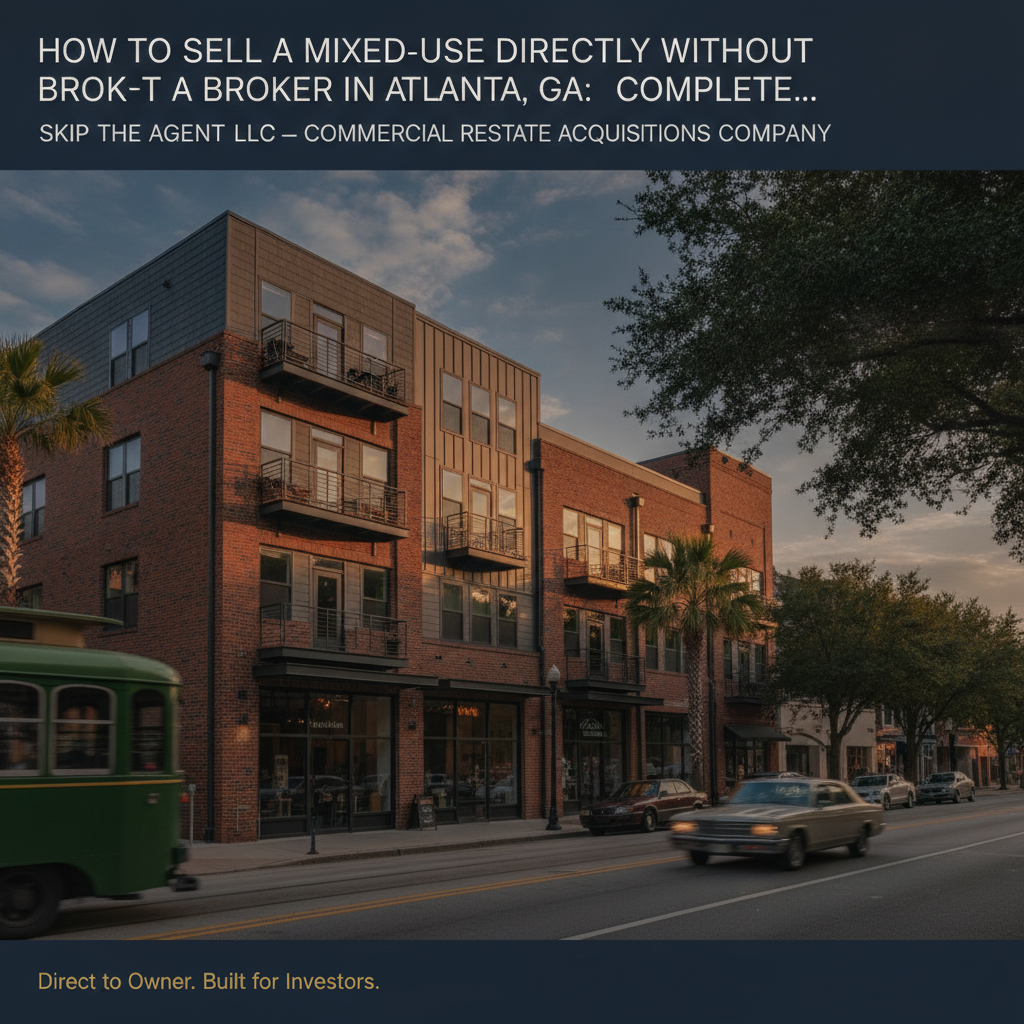
How to Sell a Mixed-Use Directly Without a Broker in Atlanta, GA: A Complete Guide
Selling a mixed-use property directly in Atlanta means going straight to a vetted buyer pool without listing on LoopNet, paying a 4-6% broker commission, or exposing your tenants to a public sale process. Mixed-use assets in Atlanta are currently clearing at cap rates roughly in the mid-5s to low-7s and pricing around $275-$425/SF, with multifamily-heavy mixed-use trading near a 5.6% cap and retail components closer to 6.55%, according to CBRE data summarized in Q1 2026 market reports. Skip The Agent connects Atlanta mixed-use owners directly with verified investors who underwrite fast, close on cash or short bridge terms, and skip the months-long listing cycle entirely.
You own a mixed-use building in Atlanta with ground-floor retail and apartments above, or maybe office over street-level restaurant space, and you have decided the listing route does not fit your timeline, your tenants, or your tolerance for showings. This guide walks through exactly what your asset is worth in the current Atlanta market, who buys properties like yours off-market, and when a direct sale beats hiring a brokerage, plus the honest cases where it does not.
What Mixed-Use Commercial Real Estate Actually Is
Mixed-use describes a single property that combines two or more income-producing uses under one roof or on one parcel. In Atlanta, the most common configurations are:
- Retail over residential, ground-floor shops, cafes, or service tenants with 5+ apartments above (think Virginia-Highland, Inman Park, Grant Park, Kirkwood)
- Office over retail, professional suites stacked on street-level commercial (common along Peachtree corridors and in Decatur)
- Live-work and flex mixed-use, light industrial or maker space combined with residential or office (Westside, BeltLine-adjacent submarkets)
- Hospitality-anchored mixed-use, boutique hotel with restaurant, retail, or residential components
Mixed-use commercial real estate is a single property that generates income from two or more distinct uses, most commonly ground-floor retail or restaurant space with multifamily apartments or office above. In Atlanta, mixed-use assets typically range from 8,000 to 60,000 square feet and trade based on a blended cap rate that weights each component’s market rate.
For Skip The Agent’s commercial division, mixed-use deals start at $500,000 in value and scale into the eight figures. We do not classify duplex, triplex, or fourplex stacks as commercial multifamily, the residential component must include 5 or more units to qualify.
Who Owns Atlanta Mixed-Use Properties and Why They Sell
The Atlanta mixed-use owner base is more fragmented than office or industrial. Most assets are held by:
Long-hold local operators. Families or individuals who bought intown buildings in the 1990s or 2000s, often for under $1 million, now sitting on properties worth $3-8 million. Many are tired of tenant turnover, code compliance, and BeltLine-driven property tax increases.
Merchant developers facing loan maturity. A meaningful share of mixed-use product delivered in 2020-2022 was financed with 3 to 5 year bridge or construction-to-perm debt. Those loans are coming due now, and with refinance proceeds compressed by higher rates, many of these owners are quiet sellers.
Out-of-state or absentee owners. Atlanta attracted significant out-of-state capital during the 2021 buying surge. Several of those buyers paid 4.5-5.0% cap pricing and are now sitting on assets that would re-trade at 5.5-6.5%. Management fatigue plus negative leverage drives them to exit.
Estate and partnership situations. Death, divorce, partnership dissolution, and 1031 exchange deadlines are the most predictable drivers of off-market mixed-use trades in Atlanta.
If you fall into any of these buckets, the direct sale path for Atlanta sellers is worth understanding before you sign a listing agreement.
What Atlanta Mixed-Use Investors Look For
Investors sourcing off-market mixed-use in Atlanta are typically syndicators, family offices, or private capital groups that already own in the metro. They underwrite to a short, specific list:
- Blended cap rate at or above market, they will not pay multifamily-only pricing for a building that is 40% retail
- Walkable submarket, proximity to the BeltLine, MARTA, or established commercial corridors
- Stabilized occupancy, generally 88% or better across both components
- Clean rent rolls and trailing 12 financials, they will not chase missing data
- Below-market rents with documented upside, most buyers underwrite a 12-24 month value-add plan
- Clear zoning and no environmental flags, Phase I environmental per the ASTM E1527-21 standard is standard for any property with current or historic commercial use
Atlanta mixed-use investors typically target blended cap rates of 6.0% to 7.5% on stabilized assets, with value-add deals underwritten to a stabilized yield-on-cost of 7.5% or higher. The most active buyers are local and regional syndicators sourcing through direct channels rather than LoopNet or Crexi.
If you are on the buy side and want to see how serious capital sources these deals before they hit public platforms, read Off-Market Commercial Real Estate in Atlanta, GA: How Serious Investors Source Deals Before Anyone Else.
How Atlanta Mixed-Use Valuations Actually Work
There is no clean published “mixed-use cap rate” series for Atlanta. You have to build one by weighting the components.
The Component Math
Based on Q1 2026 Atlanta data:
- Multifamily component: cap rates averaging 5.6% across all classes, with newer Class A intown product trading tighter, per CBRE data summarized by Apartment Loan Store
- Retail component: small strip and street retail at 6.44%-6.55%, single-tenant net lease at 6.80%
- Office component: multi-tenant Class A/B at 7.6%-8.0%, Class C at 8.7%-9.4%
- All-commercial Atlanta average: ~6.92% per LoopNet market data
- Atlanta multifamily price per unit: averaging $194,000/unit per the Matthews Q1 2026 Atlanta Multifamily Report
Building a Blended Cap Rate
For a typical intown Atlanta mixed-use building with 70% NOI from apartments and 30% from ground-floor retail:
- Multifamily portion: 70% × 5.6% = 3.92%
- Retail portion: 30% × 6.55% = 1.97%
- Blended cap rate: ~5.89%
If your trailing 12 NOI is $400,000, the indicated value is roughly $400,000 ÷ 5.89% = $6.79 million.
That is the underwriting starting point. From there, buyers adjust for:
- Deferred maintenance (roof, HVAC, electrical, facade)
- Lease rollover risk (especially short-term retail leases)
- Loss-to-lease if rents are below market
- CapEx reserves typically $250-$500/unit/year for residential plus a TI/LC reserve for commercial
Price-per-SF and Price-per-Unit Sanity Checks
Atlanta commercial assets are averaging $355/SF on purchases per LoopNet 2026 data. Mixed-use in walkable intown submarkets generally clears between $275 and $425/SF, with newer construction in BeltLine-adjacent submarkets pushing higher. On a per-unit basis, residential-dominant mixed-use is trading roughly $230,000-$320,000 per unit depending on unit size, finish level, and ground-floor income.
Mixed-use property values in Atlanta are calculated by blending the cap rates of each income stream, then applying that blended rate to the trailing 12-month NOI. A property with 70% multifamily NOI and 30% retail NOI in 2026 Atlanta typically clears around a 5.9% blended cap, which translates to roughly $300,000 per residential unit equivalent in walkable intown submarkets.
For deeper context on how this market is moving, see the Atlanta, GA Commercial Real Estate Market Update: Cap Rates, Vacancy, and What’s Moving Right Now.
Typical Deal Timelines: Direct vs. Listed
Here is the honest comparison.
Listed Sale Through a Brokerage
- Listing prep and OM creation: 3-6 weeks
- Marketing period: 6-12 weeks
- Offer negotiation and LOI: 2-4 weeks
- Contract through due diligence: 45-75 days
- Closing: 30-45 days after DD
- Total: typically 6 to 10 months
- Commission: 4-6% of sale price
Direct Sale to a Vetted Buyer
- Initial conversation and underwriting: 5-10 days
- Written offer with math shown: within 2 weeks
- Contract and earnest money: within 1 week of LOI acceptance
- Due diligence: 21-45 days depending on environmental and financial complexity
- Closing: 14-30 days after DD
- Total: often 45 to 90 days
- No commission to the seller
The direct path is not faster because corners get cut. It is faster because there is no marketing period, no broker back-and-forth, and the buyer is already underwriting before the first call ends.
When a Direct Sale Is the Wrong Choice
This is where most companies in our space stop being honest. We will not.
A direct sale is not the right move for you if:
- Your property is trophy-grade with multiple likely bidders. A new-construction, fully-leased mixed-use building on the BeltLine with a 95%+ occupancy rate and credit retail tenants will probably get the highest price through a competitive marketed process run by a strong investment sales team. The premium often more than covers the commission.
- You have unlimited time and want to maximize headline price. If your hold strategy allows 9-12 months and you do not mind tours, inspections, and renegotiations, full market exposure can produce a higher number.
- Your financials are messy and you need a broker to repackage the story. Good investment sales brokers earn their fee by cleaning up rent rolls, normalizing expenses, and crafting a defensible OM that supports a stretch valuation.
If any of those describe your situation, hire a reputable Atlanta brokerage. We will tell you that directly when we underwrite your property and reach the same conclusion. For a wider comparison, How to Sell Commercial Real Estate: Direct Sale, Broker, and What Actually Works lays out the full trade-offs.
A direct sale is the right move if you value speed, certainty, privacy, and net-after-cost over chasing the absolute top of the market.
How Skip The Agent’s Direct Acquisition Model Works for Mixed-Use
Our model is built around one simple idea: real math, no surprises.
Step 1, Conversation. You tell us about the property: address, unit mix, current rents, trailing 12 income and expenses, debt situation, and timeline. No NDAs at this stage. No pressure.
Step 2, Underwriting. We pull comparable sales from CoStar, verify rent comps, and build a blended cap rate model specific to your asset. We share the math with you.
Step 3, Offer. Within 7-14 days of receiving full financials, we present a written offer with the underwriting attached. You see exactly how we arrived at the number. If our offer cannot beat what a listed sale would net you after commission, we say so.
Step 4, Match to buyer. Our investor network includes verified syndicators, family offices, and private capital groups already active in Atlanta. The buyer who closes is the one underwriting closest to your number with the cleanest terms.
Step 5, Close. Earnest money, due diligence, closing. Title company of your choice. You pay no commission to Skip The Agent.
Skip The Agent is not a licensed broker or brokerage. We are a direct-to-owner acquisition platform that matches off-market commercial properties with verified buyers, then steps aside at closing. Sellers pay no commission and the buyer pays standard closing costs per the purchase contract.
For sellers who want to understand the mechanics in more detail, How Commercial Real Estate Wholesale Deals Work: A Straight-Talk Guide for Sellers and Investors walks through every step.
Why Direct-to-Owner Benefits Both Sides
The traditional listed-sale model has structural problems that hurt both sellers and buyers in the current Atlanta market.
For sellers, public listings on LoopNet or Crexi telegraph distress to tenants, lenders, and competitors. They invite a procession of low-conviction tire-kickers. They cost 4-6% in commission at close. And in a market where cap rates have expanded 75-150 basis points since 2022, that commission can wipe out the entire premium that broad exposure was supposed to create.
For buyers, the public market is recycled inventory. By the time a deal hits LoopNet, it has been shopped to off-market networks, often passed over, and what remains is either fully-priced or compromised. The buyers who consistently win in Atlanta mixed-use are the ones sourcing direct.
Direct-to-owner transactions work because they align the simple economics: a seller who wants speed and certainty, a buyer who wants real deal flow, and a price grounded in current market math that both sides can defend. No commission siphon. No marketing theater. No surprises in the closing statement.
That is what we mean by fair math. We only make money when sellers reach a fair outcome and buyers close on a property that underwrites. Lowball offers get rejected, and we do not get paid. So we do not send them.
If you own a mixed-use property in Atlanta and want to see what your building underwrites to in the current market, reach out directly. We will show you the math, tell you honestly whether a direct sale fits your situation, and point you toward a brokerage if it does not.
Frequently Asked Questions
What is the average cap rate for mixed-use properties in Atlanta in 2026?
Mixed-use cap rates in Atlanta currently range from roughly 5.5% to 7.5% depending on the use mix, location, and tenant quality. Multifamily-heavy mixed-use in walkable intown submarkets trades closest to the 5.6% multifamily average reported by CBRE, while retail-heavy or office-heavy mixed-use clears in the high-6% to low-8% range. The blended cap rate is calculated by weighting each income stream by its share of total NOI.
How long does it take to sell a mixed-use property directly without a broker in Atlanta?
A direct sale of an Atlanta mixed-use property typically closes in 45 to 90 days from first conversation to funded close, compared to 6 to 10 months for a brokered listing. The compressed timeline comes from skipping the marketing period and working with a pre-qualified buyer who is already underwriting before the contract is signed. Due diligence still takes 21 to 45 days because environmental, title, and financial review do not shortcut.
What is the difference between mixed-use and multifamily for commercial valuation purposes?
Mixed-use combines two or more income-producing uses on one property, while multifamily refers to a residential-only asset with 5 or more units. The valuation difference is significant: pure multifamily in Atlanta is trading near a 5.6% cap, while mixed-use with retail or office components carries a blended cap rate that is typically 50 to 150 basis points wider. Lenders also underwrite the two asset types differently, with mixed-use generally requiring more equity.
Do I have to pay a commission if I sell my Atlanta mixed-use property directly to Skip The Agent’s buyer network?
No, sellers pay no commission to Skip The Agent when they sell directly through our acquisition platform. Skip The Agent is not a licensed broker or brokerage and does not charge sellers a listing fee, commission, or success fee. Standard closing costs such as title, escrow, and transfer taxes are handled per the purchase contract, typically split per Georgia custom.
How do I know if my mixed-use building qualifies for an off-market direct sale?
Skip The Agent’s commercial division acquires mixed-use properties valued at $500,000 or more, with at least 5 residential units if the residential component is dominant. The property should have a documented trailing 12 months of income and expenses, a current rent roll, and no active litigation that would prevent a clean transfer. Distressed, partially vacant, and value-add properties are welcome, what matters is that the math supports a real offer.
What are investors actually paying per unit for mixed-use buildings in Atlanta right now?
Mixed-use buildings in Atlanta with a residential-dominant configuration are generally trading between $230,000 and $320,000 per residential unit equivalent in 2026, depending on submarket, unit size, and ground-floor income contribution. The Matthews Q1 2026 Atlanta Multifamily Report shows the broader Atlanta multifamily average at $194,000 per unit, and mixed-use in walkable BeltLine-adjacent submarkets typically trades at a premium to that average. On a per-square-foot basis, expect $275 to $425/SF for stabilized assets.
Should I list my Atlanta mixed-use property publicly on LoopNet or sell off-market?
List publicly if your property is trophy-grade, fully stabilized, and likely to attract multiple competitive bidders, because broad market exposure can produce a premium that covers the 4-6% commission. Sell off-market if you value speed, privacy from tenants and lenders, certainty of close, and net proceeds after costs. In a market where Atlanta cap rates have expanded 75-150 basis points since 2022, the commission savings from a direct sale frequently offset any pricing premium a listed sale would have produced.
Who are the typical buyers for off-market mixed-use deals in Atlanta?
The most active off-market buyers for Atlanta mixed-use are regional syndicators, family offices, and private capital groups that already own in the metro and have the underwriting infrastructure to move fast. These buyers typically deploy $2 million to $25 million per deal, close with cash or short-term bridge debt, and prioritize repeat deal flow over chasing every listing on LoopNet or Crexi. They underwrite to a stabilized yield-on-cost of 7.5% or higher on value-add deals.
Written by Addai Lewellen and Grant Umali, co-founders of Skip The Agent LLC. Addai brings deep experience in commercial real estate acquisitions and deal structuring across national markets. Grant leads operations, marketing, and investor relations. They handle every commercial deal personally, reach them at skiptheagent.llc/commercial or (574) 702-1622.
Have a Commercial Property to Sell?
We buy directly from owners — no agent, no commission, no public listing. Get a direct offer within 48 hours on any commercial asset above $500K.
All commercial assets above $500K · Nationwide · Response within 48 hours
Not ready to call yet?
Get our latest market updates, seller guides, and real estate insights delivered straight to your inbox. No spam, no pressure.
One email. No spam. No pressure.