Deficiency Judgment After Foreclosure: Which States Let the Lender Come After You
Skip The AgentA deficiency judgment is a court order for the difference between what you owed on the mortgage and what the foreclosure sale brought in, and in most states the lender can get one and collect it from your wages and bank accounts. California, Oregon, Washington and Arizona bar deficiencies after the usual nonjudicial sale of an owner-occupied home, while New York gives the lender only 90 days to ask and Texas gives it two years. If the sale has not happened yet, Skip The Agent buys houses in foreclosure as-is, makes a written cash offer in 24 hours and can close in as few as 7 days, which pays the loan off before a deficiency can exist.
The house sold at auction. The sheriff or the trustee handed the deed to someone else, you moved out, and you assumed that was the end of it. Then a letter arrives from the lender’s attorney, or a process server, and the number on it is the part of the loan the auction did not cover.
That number is the deficiency. Whether the lender can collect it depends almost entirely on which state the house was in, how the foreclosure was run, and what kind of loan it was. This guide walks through all three, names the statutes, and tells you what the window looks like in the states where the answer is yes.
This is not legal advice. Deficiency law is state law, the exceptions are narrow, and anyone who has been served with a deficiency suit needs a lawyer licensed in the state where the property sat.
The Deficiency Is a Subtraction, and the Lender Picks the Starting Number
Start with the total the lender says you owed on the sale date: unpaid principal, accrued interest, late fees, the lender’s attorney fees and the costs of the foreclosure itself. Subtract what the property brought at the sale. What remains is the deficiency.
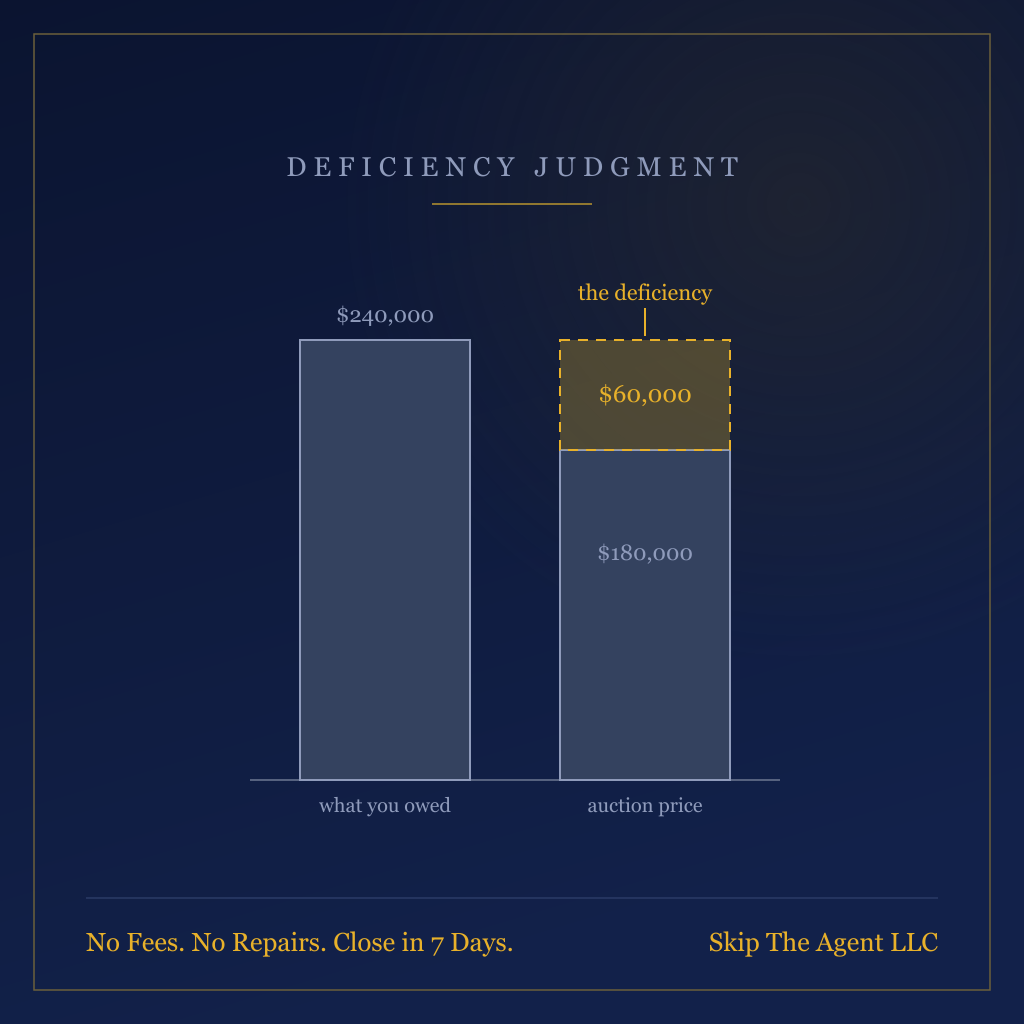
Say you owed $240,000 by the time all the fees were added. The house sold at auction for $180,000. The deficiency is $60,000, and in a state that allows it, the lender can ask a court to turn that $60,000 into a personal money judgment against you.
Auction prices run low. Buyers at a foreclosure sale usually cannot inspect the inside, often have to pay cash within a day or two, and take the property with whatever problems it has. Lenders frequently bid the property in themselves for less than market value. That gap between an auction price and a market price is the reason several states now make the lender credit you with the property’s fair market value instead of the auction price, which we cover below.
Judicial and Nonjudicial Foreclosure Decide Most of the Answer
Every state forecloses in one of two ways, and many allow both.
A judicial foreclosure goes through a lawsuit. The lender sues, a judge enters a judgment, and a sheriff or court officer sells the property. Because a court is already involved, the lender can usually ask for a deficiency in the same case. Indiana, New York, Florida and Pennsylvania are judicial states.
A nonjudicial foreclosure runs outside court under a power of sale written into a deed of trust. A trustee sends the notices, sets the date and holds the auction. No judge ever looks at the case. California, Texas, Arizona, Washington and Oregon use this route for most home loans.
The two routes matter for deficiencies because several states made a trade: a lender that chooses the faster nonjudicial sale gives up the right to chase the borrower for the rest. If your house went through a trustee’s sale in one of those states, the deficiency is usually dead on arrival.
The States That Bar a Deficiency on the Common Home Loan
These are the protections people mean when they say “anti-deficiency statute.” Each one has conditions, and the conditions are where lenders win when they win.
California. Code of Civil Procedure section 580d says that no deficiency “shall be owed or collected” on a note secured by a deed of trust or mortgage once the property has been sold under a power of sale. That covers almost every California home foreclosure, because almost all of them are trustee’s sales. A second statute, section 580b, separately protects the loan you used to buy a dwelling of up to four units that you lived in, even if the lender goes to court instead.
Oregon. ORS 86.797 bars a deficiency action after a trustee’s sale and also after a judicial foreclosure of a residential trust deed. Oregon is one of the few states where choosing the courthouse does not bring the deficiency back for a home loan.
Washington. RCW 61.24.100 states that a deficiency judgment “shall not be obtained” against any borrower, grantor or guarantor after a trustee’s sale. The protection covers noncommercial loans. A loan made for business purposes follows separate rules in the same section that do allow a deficiency in some cases.
Arizona. A.R.S. 33-814 protects trust property of two and a half acres or less that is limited to and used as a single one-family or two-family dwelling. For that property, no action may be brought for the shortfall after a trustee’s sale. Houses owned by a construction business, and houses never finished or never lived in, fall outside the protection.
Look at what all four have in common. The protection attaches to a home, usually one you lived in, sold through the nonjudicial route. A rental portfolio, a second loan taken out years after purchase, a cash-out refinance or a business loan secured by the house can each land outside the statute depending on the state. If any of those describe your loan, do not assume the protection applies until a lawyer has read the note.
The States That Allow It, and How Long the Lender Has to Ask
Most states allow a deficiency. What varies is the deadline and how the shortfall is measured.
| State | Deadline for the lender | How the deficiency is measured | Source |
|---|---|---|---|
| New York | 90 days after the sale is completed | Debt minus the higher of sale price or court-set market value | RPAPL 1371 |
| Arizona (unprotected property) | 90 days after the trustee’s sale | Debt minus the higher of sale price or fair market value | A.R.S. 33-814(A) |
| Texas | 2 years after the foreclosure sale | Borrower can ask the court for a fair market value credit | Prop. Code 51.003 |
| Florida (1 to 4 family home) | 1 year after the clerk issues the certificate or the lender accepts a deed in lieu | Set by the court in the foreclosure case or a separate suit | Fla. Stat. 95.11 |
| Indiana | Requested in the foreclosure suit | Debt minus sale proceeds | Our Indiana guide |
New York is the strictest of the states that allow a deficiency. Under RPAPL 1371 the lender has to move for a deficiency judgment within 90 days of the sale, and the court subtracts either the sale price or the market value it sets, “whichever shall be the higher.” If the lender misses that motion, the statute says the sale proceeds are “deemed to be in full satisfaction of the mortgage debt.” Ninety days is short, and lenders miss it.
Texas gives the lender far more room. Property Code 51.003 allows a deficiency action within two years of the foreclosure sale. The same section lets you ask the court to find the property’s fair market value on the sale date, using comparable sales and expert testimony, and if that value is higher than the auction price you get the difference as a credit. You have to raise it. The court does not do it for you.
Florida gives the lender one year. For a one-to-four family home, Florida Statutes 95.11 requires a separate deficiency action to be brought within one year, starting the day after the clerk issues the certificate of title or the day after the lender accepts a deed in lieu.
Indiana lets the lender request a deficiency as part of the foreclosure suit, and our guide to what happens after a sheriff sale in Indiana walks through how that judgment is enforced there. Indiana is the worked example for everything in this section: judicial state, no post-sale redemption, deficiency available.
The fair market value rules in New York, Arizona and Texas are worth your attention even if you are not in those states. They show why the auction price alone is a bad measure of what you owe, and in any state a lawyer defending a deficiency suit will look at what the lender paid for the property and what it later resold it for.
Once It Is a Judgment, It Lasts for Years
A deficiency judgment is an ordinary money judgment. It does not expire when the foreclosure ends, and the enforcement period is set by each state’s general judgment law.
In California, for example, CCP 683.020 makes a money judgment enforceable for 10 years from entry, and CCP 683.110 allows it to be renewed. Florida gives a judgment 20 years under the same section 95.11 cited above. Indiana’s is also 20 years, with renewal possible. Interest runs the whole time at the state’s judgment rate, so a $60,000 deficiency left alone for a decade is a much larger number by the time anyone tries to collect it.
Debt buyers purchase old deficiency judgments for cents on the dollar and collect on them years later. Many people discover theirs when a bank account is frozen or when a title search on a new house turns up a judgment lien.
What the Lender Can Take
A judgment creditor collects the same way any creditor with a court judgment does: wage garnishment, bank levies, and liens on other real estate you own.
Federal law caps the wage piece. Under 15 U.S.C. 1673, a garnishment cannot take more than the lesser of 25% of your weekly disposable earnings or the amount by which those earnings exceed 30 times the federal minimum hourly wage. At the $7.25 federal minimum, that protects the first $217.50 of weekly disposable pay entirely. Some states set lower caps, and a few, Texas among them, bar wage garnishment for most consumer debts.
A judgment lien on other property is the enforcement tool people forget. If you own a second property, inherit one, or buy a new home later, the deficiency can attach to it.
The Tax Bill When the Lender Forgives the Balance
If the lender writes off the deficiency instead of chasing it, or agrees to waive it as part of a short sale or deed in lieu, you may owe income tax on the forgiven amount. The lender reports it on Form 1099-C.
For years a federal exclusion shielded most forgiven mortgage debt on a primary home. That exclusion is gone for new cases. IRS Publication 4681 states that qualified principal residence indebtedness “cannot be excluded from income for discharges completed or discharge agreements entered into after December 31, 2025.” A foreclosure, short sale or waiver agreed to in 2026 does not get that exclusion unless the written agreement was signed before January 1, 2026.
The insolvency exclusion still applies. Publication 4681 lets you exclude forgiven debt to the extent your total liabilities exceeded the fair market value of all your assets immediately before the cancellation. Many people coming out of a foreclosure qualify, but you have to file Form 982 to claim it. Talk to a tax preparer before April, not after.
The Only Reliable Way to Eliminate the Exposure
Everything above happens after the sale. The protections are real in four states and narrow everywhere else. The one move that removes a deficiency in every state is keeping the house from going to auction at all.
If you have equity, a sale before the foreclosure date pays the loan in full, including the arrears and fees, and you keep whatever is left. No shortfall exists, so there is nothing to pursue. This is where a fast cash sale earns its place: a listed house rarely closes before a sale date that is weeks away, and a cash buyer can.
If you owe more than the house is worth, a short sale or deed in lieu can still end the debt, but only if the lender agrees in writing. The CFPB’s guidance on short sales warns that in some states the lender can still sue you for the deficiency after a short sale, and its guidance on a deed in lieu says the same thing: ask the lender to waive the deficiency, and get the waiver in writing. An approval letter that does not say “waive” or “release” the deficiency does not protect you.
If the sale date is set and you are not sure which of these you are in, start with how to stop a foreclosure and your options when you are behind on the mortgage. If the sale already happened, the credit damage has a known shape and a known end date, and rebuilding credit after a foreclosure covers it.
Frequently Asked Questions
Can a lender sue me after foreclosure?
In most states, yes, if the sale brought in less than you owed. The lender asks a court for a deficiency judgment, either inside the foreclosure case or in a separate lawsuit, and then collects it like any other money judgment. California, Oregon, Washington and Arizona bar a deficiency after the usual nonjudicial sale of an owner-occupied home, and New York cuts the lender off if it does not ask within 90 days.
How long can a lender pursue a deficiency?
There are two clocks. The first is the deadline to get the judgment: 90 days after the sale in New York and Arizona, one year in Florida for a one-to-four family home, and two years in Texas. The second is how long the judgment lasts once entered, which is 10 years in California with renewal allowed and 20 years in Florida and Indiana.
Can they garnish my wages for a deficiency judgment?
Yes, in most states, within federal limits. A garnishment cannot take more than 25% of your weekly disposable earnings or the amount above 30 times the federal minimum wage, whichever is less, and some states set lower caps or bar wage garnishment for consumer debt.
Does a short sale or deed in lieu get rid of the deficiency?
Only if the lender agrees to waive it in writing. The CFPB warns that in some states a lender can still sue for the shortfall after a short sale or deed in lieu, so the approval letter needs to state that the remaining balance is waived or released.
Will I owe taxes if the lender forgives the deficiency?
Possibly. Forgiven debt is reported on Form 1099-C and counts as income unless an exclusion applies, and the main exclusion for home mortgage debt ended for discharges after December 31, 2025. The insolvency exclusion still works if your debts exceeded your assets right before the cancellation, and you claim it on Form 982.
Written by Addai Lewellen and Grant Umali, co-founders of Skip The Agent LLC. Addai is a lifelong Indiana resident with deep experience in the Indianapolis and Midwest real estate market. Grant brings a background in marketing, sales, and customer success. They handle every deal personally. Reach them directly at skiptheagent.llc.
Facing foreclosure? We can close before your court date.
We close before the sale date, pay the lender directly, and you walk away without a deficiency following you. Written offer in 24 hours. No repairs, no commissions, nothing out of pocket.
Get My Free Cash OfferCloses in as few as 7 days · No repairs needed · 100% free to request
Foreclosure guides in other cities
Not ready to call yet?
Get our latest market updates, seller guides, and real estate insights delivered straight to your inbox. No spam, no pressure.
One email. No spam. No pressure.