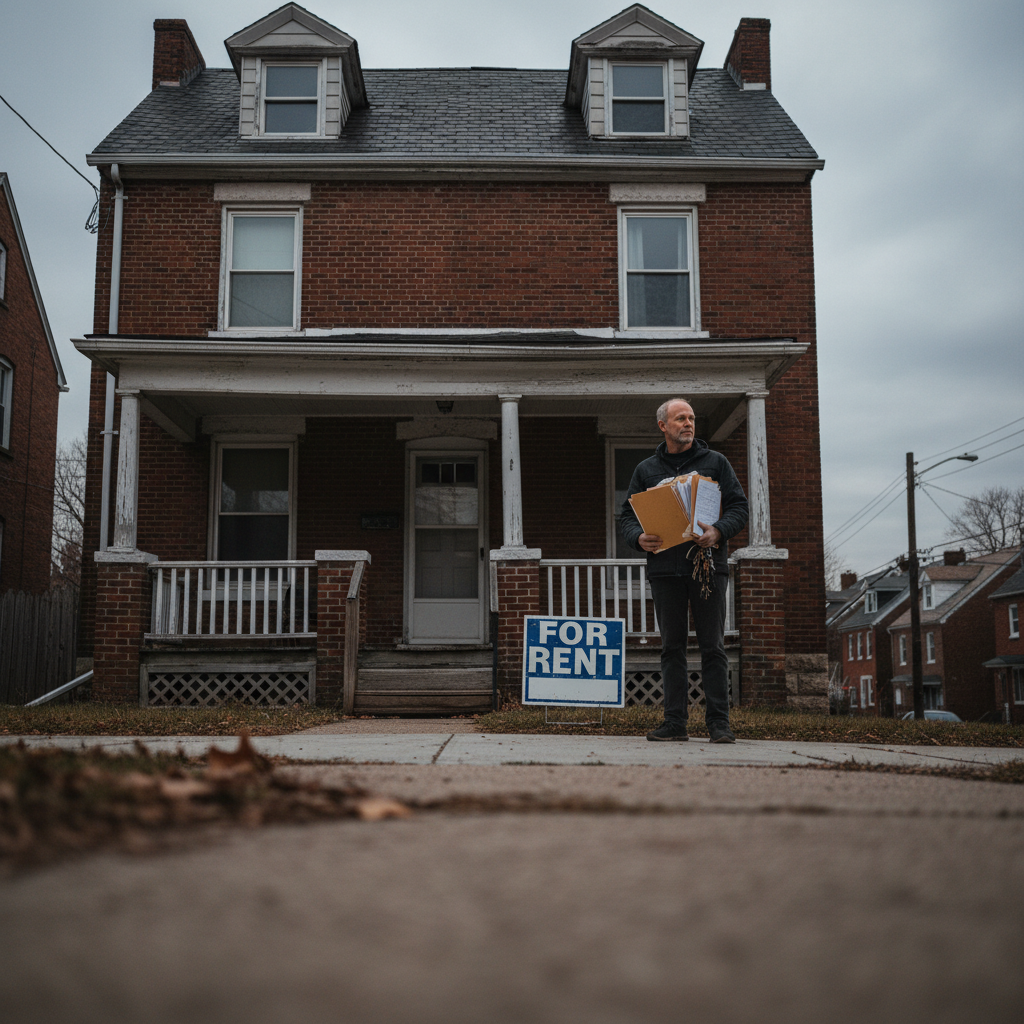
Selling a rental property when you are a burned-out landlord usually comes down to one decision: list it on the open market and manage tenants through showings, or sell it as-is to a cash buyer who closes around the existing lease. In Pennsylvania, a standard eviction can take 60 to 90 days from notice to lockout (10-day notice, 7-15 day hearing window, 10-day appeal period, plus another 10-15 days for the constable to execute the order), which is why many tired landlords choose the cash route. Skip The Agent buys rental properties as-is with tenants in place, delivers a written offer within 24 hours, and can close in as little as 7 days with zero fees charged to the seller.
You bought the duplex in Lawrenceville or the single-family in Penn Hills thinking it would build wealth. Ten years and three bad tenants later, you are answering 11 p.m. calls about water heaters, eating a $2,400 vacancy month, and wondering if the equity is worth what the property is doing to your weekends.
This guide is written for one specific person: the landlord who is mentally done. The owner who has stopped reinvesting in the property, who dreads the next lease renewal, who has a furnace on its last legs and a tenant who pays late every month. If that is you, whether you own one rental in Bloomfield or six scattered across Allegheny County, keep reading. If you still enjoy the business and just need a property manager, this is not your article.
Why Tired Landlord Burnout Is Different From a Normal Sale
A normal home sale is logistical. A tired landlord sale is emotional, operational, and legal all at once. You are not just selling drywall and a roof. You are exiting a small business that has tenants, lease obligations, deferred maintenance, security deposits, and possibly a paper trail of code complaints or late-payment notices.
The complications stack:
- Tenants in place who may or may not cooperate with showings
- Deferred maintenance you have been putting off for two or three years
- Capital expenses on the horizon (roof, HVAC, sewer lateral, electrical panel)
- Tax consequences like depreciation recapture and capital gains
- Tenant rights under Pennsylvania’s Landlord and Tenant Act of 1951
- Local regulations, including Pittsburgh’s rental registration and inspection requirements
Each of these can derail a traditional listing. A buyer’s inspector finds knob-and-tube wiring. A tenant refuses access for the appraisal. The furnace dies in February while the property is under contract. Any one of these can cost you $5,000 to $20,000 or kill the deal entirely.
The Honest Financial Picture
Before you decide how to sell, run the math on what staying costs versus what leaving costs.
What You Are Actually Earning
Take your gross annual rent. Subtract: vacancy (assume 8%), property taxes, insurance, repairs and maintenance (industry standard is 1% of property value per year), capital reserves (another 1%), property management if you use it (8-10% of rent), and your time. Most tired landlords discover their real cash-on-cash return is between 2% and 5%, not the 8-12% the spreadsheet showed when they bought.
If you have $120,000 in equity earning a real 3%, that is $3,600 a year for the headache of being a landlord. The same equity in a high-yield savings account or index fund, with zero tenant calls, often beats that.
What a Traditional Sale Will Cost You
On a $260,000 Pittsburgh rental (close to the median per Redfin data showing a median sale price of $260K), here is the realistic cost breakdown of listing with an agent:
- Agent commissions: 5-6% = $13,000 to $15,600
- Seller concessions to buyer: 1-3% = $2,600 to $7,800
- Pre-listing repairs: $5,000 to $25,000 for a deferred-maintenance rental
- Cleaning, paint, turnover: $2,000 to $6,000 (assuming you have to relist with the unit vacant)
- Holding costs during marketing: 60-90 days of taxes, insurance, utilities, mortgage
- Tenant buyout or cash-for-keys: $1,500 to $5,000 if you want them out before listing
- Transfer tax: Pittsburgh’s combined state, city, and school transfer tax is 5% (split, but commonly a chunk falls on the seller)
A landlord with deferred maintenance can easily spend $25,000 to $45,000 to net the “full market price.” For an honest comparison of what selling actually costs, our breakdown in What Does It Actually Cost to Sell a House? Every Fee Explained walks through every line item.
The Tenant Problem (And the Pennsylvania Timeline)
Here is where many tired landlords get stuck: you cannot just put a “For Sale” sign in the yard and ignore the people living inside.
Selling With Tenants in Place
Legally, you can sell a tenanted property at any time. The lease transfers with the property. The new owner becomes the new landlord and inherits the terms. The catch: most retail buyers (the people scrolling Zillow looking for a home to live in) will not touch a tenanted property. Your buyer pool shrinks to other investors, who will price the property based on the rent it generates, not what it could sell for to an owner-occupant.
Selling Vacant (and the Eviction Timeline)
If you want top dollar from an owner-occupant buyer, the property typically needs to be vacant. Getting there is the hard part.
Pennsylvania’s eviction process under the Landlord and Tenant Act of 1951:
- 10-day written notice for nonpayment or lease violation
- 15-30 day notice for end-of-term or no-cause month-to-month
- File complaint at Magisterial District Court in the property’s jurisdiction
- Hearing scheduled within 7-15 days of filing
- 10-day appeal/vacate window after judgment
- Order for Possession issued after that window
- Constable serves and executes lockout 10-15 days later
Realistic timeline from first notice to physical possession: 60 to 90 days if everything goes smoothly. Add 30-60 days if the tenant contests or appeals. Self-help (changing locks, shutting off utilities, removing belongings) is illegal in Pennsylvania and exposes you to significant tenant damages.
In Pennsylvania, a landlord can sell a rental property with tenants in place at any time without their permission, and the existing lease transfers to the new owner. To sell vacant, the landlord must give proper written notice (10 days for cause, 15-30 days for end-of-term) and follow the magisterial district court eviction process, which typically takes 60 to 90 days from notice to lockout when uncontested.
Cash-for-Keys: Often the Cheaper Path
If the tenant is not paying or you need them out fast, formal eviction may not be your best move. A “cash-for-keys” arrangement, where you pay the tenant $1,000 to $4,000 to leave by an agreed date in broom-clean condition, is often faster and cheaper than eviction. Have a lawyer draft the agreement, get the keys in hand, document the condition, and release the payment.
When a Cash Sale Is the Right Call
Be honest with yourself. A cash sale to a buyer like Skip The Agent makes sense when:
- The property has significant deferred maintenance you do not want to fund
- You have problem tenants you do not want to manage through a listing
- You want certainty of closing without inspection renegotiations or financing fall-throughs
- You need to exit on a specific timeline (1031 exchange deadline, divorce, retirement, out-of-state move)
- You own multiple properties and want to sell the portfolio in one transaction
- The emotional cost of continuing to manage the property outweighs the spread between cash offer and retail price
A cash offer on a Pittsburgh rental typically lands at 70-85% of the as-is retail value, with the spread covering the buyer’s repair budget, holding costs, and margin. On a $260,000 property, that might be $195,000 to $220,000 in your pocket, with zero commissions, zero closing costs, zero repairs, and zero showings.
Compare that to listing: $260,000 retail price, minus $15,000 in commissions, minus $20,000 in repairs, minus $7,000 in concessions and closing costs, minus three months of carrying costs = $210,000 net after four to six months of work. The numbers are often closer than landlords expect. For more detail on this comparison, see How Cash Offers Work, And Why They Make Sense for the Right Seller.
When a Cash Sale Is NOT the Right Call
I am going to be direct here, because the FAIR-MATH mandate matters: a cash sale is the wrong move for some landlords.
List with an agent if:
- Your property is in excellent condition, recently updated, with a reliable tenant who will cooperate with showings
- You have strong equity, no time pressure, and the bandwidth to manage a 60-90 day listing
- The property is in a high-demand neighborhood (Squirrel Hill, Shadyside, Lawrenceville core) where bidding wars happen
- You are willing to wait for the right owner-occupant buyer to maximize price
- Your tenants are at the end of their lease and will be out before listing
If three or more of those apply to you, get an agent. The 5-6% commission will be worth it. Honest answer.
For landlords in the middle, FSBO vs Cash Buyer in Indiana: Which Option Is Actually Better for You? covers the decision framework (and the principles apply nationally, not just in Indiana).
The Step-by-Step Process for a Tired Landlord Sale
Step 1: Get the Numbers
Pull together:
- Current mortgage balance and payoff
- Annual property tax bill (Allegheny County)
- Insurance premium (rates have climbed sharply, per Bankrate home insurance data)
- Last 12 months of rent collected
- Last 24 months of repair receipts
- Pending capital expenses (roof age, HVAC age, electrical, plumbing)
- Tenant ledger and current lease
You need this whether you list or sell to a cash buyer. It is also how you tell whether the property is making you money.
Step 2: Decide on Tenant Strategy
Three options:
- Sell with tenant in place to an investor buyer (lower price, no displacement)
- Cash-for-keys to vacate the property (mid-range cost, faster than eviction)
- Formal eviction if the tenant is non-paying or violating the lease (slowest, most expensive)
Step 3: Get a Real As-Is Valuation
Do not guess. Get a written cash offer from at least one credible local buyer so you know your floor. You can request a free estimate from Skip The Agent in 24 hours, with the math behind the offer transparently broken out. Even if you ultimately list with an agent, having that number gives you a real comparison.
Step 4: Compare Net Proceeds, Not Sale Prices
This is where most landlords get fooled. A $260,000 listing price and a $215,000 cash offer are not comparable until you subtract everything from the listing number. Build a side-by-side spreadsheet. Include time value of money, time you will spend, and risk of deal failure.
Step 5: Plan the Tax Hit
Depreciation recapture (taxed at up to 25%) and capital gains will take a real bite. Talk to your CPA before you sign anything. A 1031 exchange into a passive investment (DST, NNN lease) can defer both, but only if structured before the sale closes. If you are retiring, the timing of the sale relative to your income year matters.
Step 6: Close
If you go the cash route with Skip The Agent, closing can happen in as few as 7 days, or on a date you choose. We use a local title company, you sign at a time that works for you (in person or remote), and the funds wire the same day.
Common Mistakes Tired Landlords Make
Waiting too long. The property gets worse. The tenant gets harder. The deferred maintenance compounds. Insurance premiums climb. The “I will sell next spring” turns into three more spring seasons.
Trying to evict and list at the same time. This rarely works. The tenant has no incentive to cooperate, the property cannot be shown well, and buyers walk.
Underestimating repair costs. That $4,000 roof estimate from 2022 is $7,500 today. The “small” foundation crack will cost $12,000. Get current bids before assuming the listing math works.
Ignoring the emotional cost. If you are losing sleep, that is a real cost. Burnout is a financial event. The cheapest path is sometimes the one that lets you stop thinking about the property.
Not comparing offers. Cash buyers vary widely. Some lowball. Some are wholesalers who will tie up your property and try to assign the contract. Ask for proof of funds, ask for the math, and ask who is actually closing.
What Skip The Agent Offers (Concretely)
- Written cash offer within 24 hours, with the comp math and repair estimate shown
- Buy as-is: no repairs, no cleaning, no inspections you have to fix
- Buy with tenants in place or coordinate vacating, your choice
- Close in as few as 7 days, or on the date you pick
- No commissions, no closing costs charged to the seller
- We are a real local buyer, not a wholesaler. We close on what we offer.
If you own multiple Pittsburgh rentals and want to sell the portfolio, we will quote them together. If you know another landlord considering selling, our referral program pays $500 per closed referral.
The Bottom Line
Being a tired landlord is not a moral failing. It is the natural endpoint of an investment that has outgrown its purpose for you. The question is not whether to exit. The question is how, when, and at what real net number.
If your property is in good shape, your tenant is paying, and you have time, list it. If you are exhausted, the property is rough, or the math is closer than you think, get a cash offer and run the comparison honestly. Either way, do the math with real numbers, not the ones you wish were true.
When you are ready to see what your property is actually worth as-is, contact us and we will have a written offer in your hands within 24 hours. No pressure, no obligation, just real numbers you can compare to whatever else you are considering.
Frequently Asked Questions
Can I sell my rental property with tenants still living in it?
Yes, you can sell a tenanted rental property at any time without the tenant’s permission, and the existing lease transfers to the new owner who becomes the new landlord. The challenge is that most retail buyers want to live in the home themselves, so a tenanted property typically sells to investors at a price based on rental income rather than owner-occupant comps. Cash buyers like Skip The Agent regularly purchase tenanted properties and handle the transition.
How long does it take to evict a tenant in Pennsylvania before I can sell vacant?
A typical uncontested eviction in Pennsylvania takes 60 to 90 days from the first written notice to physical lockout. The process includes a 10-day notice period for cause (or 15-30 days for end-of-term), filing at the Magisterial District Court, a hearing within 7-15 days, a 10-day appeal window, and a 10-15 day period for the constable to execute the order. Contested cases or appeals can add 30-90 more days.
How much will a cash buyer offer for my Pittsburgh rental?
Cash offers in Pittsburgh typically range from 70% to 85% of the as-is retail value, depending on the property’s condition, location, and the repairs needed. On a property worth $260,000 retail, that is roughly $182,000 to $221,000 net to the seller, with no commissions, closing costs, or repair expenses deducted. The exact number depends on comparable sales, the cost to bring the property to rentable or sellable condition, and the local market.
Do I have to pay capital gains tax when I sell a rental property?
Yes, selling a rental property generally triggers both capital gains tax on appreciation and depreciation recapture tax (up to 25%) on the depreciation you claimed while owning it. You can defer both through a 1031 exchange into another investment property, but the exchange must be structured before closing with a qualified intermediary. Talk to a CPA before signing a purchase agreement so you understand the tax hit.
Is cash-for-keys legal in Pennsylvania, and is it better than eviction?
Cash-for-keys is legal in Pennsylvania and is usually faster and cheaper than formal eviction. A typical agreement pays the tenant $1,000 to $4,000 to vacate by a specific date in broom-clean condition, in exchange for releasing all claims. Have an attorney draft the agreement, document the property condition at handover, and only release payment once keys are in hand.
What is the difference between a real cash buyer and a wholesaler?
A real cash buyer has the funds (or a documented line of credit) to close on the property themselves and takes ownership at closing. A wholesaler signs a contract with you and then tries to assign that contract to an end buyer for a fee, which can lead to delays, renegotiations, or the deal falling apart if no end buyer is found. Always ask for proof of funds and ask whether the buyer is closing in their own name.
Should I make repairs before selling my rental property?
Usually no, if you are selling to a cash buyer; usually yes, if you are listing with an agent for an owner-occupant buyer. Cash buyers price the property based on as-is condition and factor repairs into their offer, so spending money upfront rarely improves your net. Retail buyers, on the other hand, often back out over inspection findings or demand large concessions, so basic repairs before listing can protect the sale price.
What if I own multiple rental properties and want to sell them all?
Many tired landlords sell their entire rental portfolio in a single transaction to a cash buyer, which simplifies tax planning and eliminates the headache of running multiple listings. Skip The Agent quotes portfolios together and can structure the closing dates around your tax year or 1031 exchange timeline. This is often the cleanest exit for landlords with three or more properties.
Written by Addai Lewellen and Grant Umali, co-founders of Skip The Agent LLC. Addai is a lifelong Indiana resident with deep experience in the Indianapolis and Midwest real estate market. Grant brings a background in marketing, sales, and customer success. They handle every deal personally. Reach them directly at skiptheagent.llc.
Done being a landlord? We buy tenant-occupied properties.
Sell with tenants in place — no eviction required. Cash offer in 24 hours, close whenever you're ready.
Get My Free Cash OfferCloses in as few as 7 days · No repairs needed · 100% free to request
Not ready to call yet?
Get our latest market updates, seller guides, and real estate insights delivered straight to your inbox. No spam, no pressure.
One email. No spam. No pressure.